Wednesday, December 5, 2012

Our visit to the Reichstag (aka Travis Gets to Sit in Angela Merkel's Chair)

As one of Berlin's most recognizable buildings, the German Reichstag (or parliament) is a popular stop on many a Berlin itinerary. However, despite its popularity, many people opt to take in only the building's exterior without venturing inside - a fact made even more surprising considering tours are free.

The newly remodeled facade of the Reichstag

Completely free attractions, especially of this calibre, are a rarity for travelers in Europe; however, in this situation it's true - with only one small catch. Visitors must register ahead of time (two weeks or more in advance, to be safe - however it only took us a couple days in the low-season) and provide passport information as well as three date/time preferences. If all checks out and you are deemed fit to visit, you will receive emailed confirmation confirming the time of your visit.

The parliament was in session during our time in Berlin, and therefore our tour was scheduled for the evening after the politicians had taken off for the night. After a quick security screening (like the airport but much more efficient), we joined the tour group and our guide.

The "fat chicken" in the plenary chamber

Lots of art brightens up the building

What can we say about our guide...a typically "German" German with a (hilarious) dry sense of humour and a seemingly boundless amount of knowledge of the history of the building and the German government. The tour lasted just over an hour and we saw meeting rooms, meditation rooms, the plenary chamber, remnants of the old structure, the tunnel that the arsonist that burnt it down may have entered from, and tons and tons of art. Oh, and Travis got to sit in Chancellor Angela Merkel's seat in the meeting room of the CDU/CSU party (sorry no picture - we had to be quick in there).


Just picture Travis smiling and being forced to make an impromptu speech (via)

The tunnel possibly used by the arsonist to burn the building down


The building in 195 after the end of the war


The architecture of the building itself is stunning. The redesign by Norman Foster, built within the shell of the previous building, is a brilliant combination of old and new. Many original walls, including one with graffiti left by Russian soldiers, are intermixed with modern and functional new aspects of the building. 

The famous graffiti left by Russian soldiers

Perhaps one of the most intriguing aspects of the Reichstag building is the abundance of art on display. The German government is obliged to spend a certain percentage (2% on average) of revenues on the arts each year, and this is represented by over 30 beautiful pieces scattered throughout the building. From sculpture to modern art, all of the pieces have intricate and deep meaning and our guide's explanation of what they were meant to convey just added to the tour.


A wall of metal boxes for each of the members of government murdered since the start of the war


The guided section of the tour ended at the entrance to the famous glass dome of the Reichstag building. While our guide made his way back downstairs, we were given audioguides and allowed to wander the dome for as long as we wanted. The (typically German) audioguides sensed where you were on the walk up the spiraling ramp to the top and back down and told you relevant information about your view across the city from that particular vantage point.

The beautiful glass dome

Looking down into the plenary chamber


The quote of the day came from our guide when, after warning us to watch our step in a tricky area of the meeting room, one of the participants (not watching their step) fell superbly onto their backside, to which he responded "I told you to watch that step...JESUS CHRIST!" 


By Unknown with 1 comment

Monday, December 3, 2012

While Calli Was on Her Photo Tour...

As Calli was heading off for the day to explore a scary, abandoned TB clinic with a group of crazy German photographers, I thought that I would make the most of my free time and visit some of Berlin's world-renowned museums. For just 14 Euro (including free audio/visual guide), I picked up a pass for all the museums on Museum Island, a UNESCO World Heritage Site, and after a quick bagel I was on my way.

A chilly Berlin morning - perfect for exploring some museums

Museum Island is a small island (who would've guessed) in the middle of the Spree. It houses 5 of Berlin's most important museums, as well as the Berliner Dom, the Lustgarten, and a number of other important buildings and attractions. 


The Berliner Dom

My first stop also happened to be the one I was most excited about - the Pergamon Museum. Named for the Pergamon Altar that is housed within, the museum contains a number of fantastic treasures mainly from the Middle and Near East. In addition to the overwhelmingly large Pergamon Altar, the museum also houses the Market gate of Miletus, the Ishtar Gate of Babylon, a reconstructed neo-Assyrian Palace, and a merchant's house from Aleppo. 

The Pergamon Altar (via)

The Market Gate of Miletus (via)

Glazed terracotta tile details on the Ishtar Gate of Babylon

Ornamentation found at the Market Gate of Miletus

My second stop was the Alte Nationalgalerie (the Old National Gallery), which contains an excellent collection of Neoclassical, Romantic, and Impressionist Art. Although heavily damaged during Allied air raids, the building has since been beautifully restored. The main focus is on German painters like Adolph Menzel and Caspar David Friedrich, but a number of works by European masters like John Constable and Auguste Renoir are also part of the collection. In addition to the paintings, a number of amazing sculptures adorn the halls. Although not as extensive or amazing as the Prado or Uffizi, it is a great collection and very nicely displayed.


The reconstructed facade of the Alte Nationalgalerie

The Abbey in the Oakwood - Caspar David Friedrich (via)

Prinzessinnengruppe - Johann Gottfried Schadow

My third stop of the day was set in stone from the beginning. The Neues (New) Museum is the only one that requires a reservation, which I made when I bought my ticket in the morning. Just after noon I made my way into the museum, which houses an extensive collection of Egyptian and prehistoric treasures, including the famed Bust of Nefertiti. Although heavily bombed during WWII, the museum has been masterfully restored by David Chipperfield, and still retains the "entering into an Egyptian Temple" feel that was intended for it. 

A painting of the initial Egyptian Temple exhibit (via)

Stone tablets from Ancient Egypt

Praying statue of King Amenemhet II (circa 1800BC)

The famed Bust of Nefertiti (via)


Fourth on the docket for the day was the Bode Museum, and its collection of Byzantine art, sculpture, coins, and medals. The building itself survived fairly intact, a rarity in the area. While not as visited as the others, it deserves a look for its great collection of sculptures and art from Byzantium and Ravenna, as well as the controversial bust of Flora (originally, and perhaps mistakenly, attributed to da Vinci).


The facade of the Bode Museum (via)

Main atrium at the entrance to the Bode Museum (via)


Although I was tired and my feet were screaming at me to stop, I figured I might as well finish up with the final of the 5 museums - the Altes Museum. Probably the most architecturally amazing building, the exterior is modeled after the Stoa of Attalos in Athens (which we visited) and the interior contains an exact replica of the hemispheric dome of the Pantheon in Rome. It holds an extensive collection of Greek, Roman, and Etruscan antiquities.

The exterior facade of the Altes Museum

The rotunda gallery with Greek sculptures (via)


Even today, the collections of the museums are being reorganized, and even added to as once-lost bunkers full of amazing treasures are being rediscovered.The museums are all worth a visit (although maybe all 5 in one day is a bit too much), and cover topics that would appeal to everyone.

By Unknown with No comments

Sunday, December 2, 2012

While Travis was Exploring Museum Island...

A bit apprehensive, I gave Travis a kiss goodbye and headed for the nearest S-bahn metro station. After ninety-six days together it felt oddly lonely to be on my own for the day. An hour later, on the outskirts of town, the train pulled up to the station - a cement pad surrounded by forest - and I nervously looked around for the tour group.

As a result of two world wars and years of division, Berlin is home to many partially destroyed or abandoned buildings, many of which hide beautiful architectural details behind their rundown exteriors. However, if you've got a few Euros, or know the right people, obtaining access to these buildings can be extremely rewarding.

One company offering such access to curious visitors is Go2Know Photo Tours. Started a few years ago by three young, adventurous, German lads, they currently offer a dozen photo tours to deserted sites including an East German youth college, Chemical Plant, and Tempelhof Airport. In addition to a focus on photography and gaining access to these sites, Go2Know also works with the owners to maintain and preserve each site. 

Although all of the tours looked amazing, my decision was limited by our short time in Berlin, and in the end I opted to visit the Men's Clinic. Built in 1902 to house tuberculosis patients, and later serving as a hospital during World War One and Two, the men's clinic was also the largest Soviet hospital outside of Russia during the cold war before finally being deserted in the early nineties. 


A forgotten vodka bottle overlooking the central courtyard

Vines beginning to take back the buildings

What was once a gymnasium

Paint peeling staircase

It didn't take long to realize I was the only native English participant on the tour, as everyone else laughed along to the German guides' quick site introduction. However the guides took some time to give me a quick run down in English, and then everyone was off, free to explore the site at their own pace.

Three buildings in total make up the site, each featuring the remains of the lovely architecture characteristic of the time-period, and it's still easy to see beauty in the dusty, water stained, hallways. The buildings also offer wonderful photo opportunities, and I found myself caught off guard by the beauty and feelings of loneliness around each corner. After 500 photos and 5 exhausting hours of exploring and shooting, it was time to leave for home and get some well-deserved rest. 

Colour is still evident in this staircase

Lovely shadows

One of many empty hallways

This door somehow made its was to the attic
The tours are all reasonably priced at around forty euros, depending on the site, and although the company website are currently available only in German, the guides did share their plans to branch out and offer more options moving forward (and are very helpful via email). However, being able to get onto the site alone was enough reason for me to sign up, and if I ever get the chance to visit Berlin again I'll be sure to fit in another Go2Know tour )or two!).

Tall Roman-esque pillars

An eerie shower room

Large, open theater space

A breaker box, although there is no longer electricity serving the buildings

*Note, the photos are all right off my camera and haven't been touched up yet. I'll let you know once I get a chance to post a final album to Flickr.

By Unknown with No comments

Saturday, December 1, 2012

The Howl of the Wolf(sburg)

With Calli lured by the promise of some outlet shopping, we boarded the train on our second day in Berlin and headed for the nearby town of Wolfsburg to watch (another) soccer game.

Home to the Volkswagen headquarters, the city owes it's size to the car manufacturer that has essentially been the sole purpose of the city since its inception. Originally set up by the Nazis in 1938 to produce the "people's car", aka the Beetle, the city has grown from just 1000 people to over 130,000 today. Today the city is full of stylish modern architecture and large parks, however, the Volkswagen factory still dominates the skyline from wherever you are.

The Volkswagen factory - always visible in Wolfsburg

Unfortunately, German outlet shopping is more pricey than the American original and we left the stores empty handed. Although this part of the trip turned out to be a disappointment, the game itself turned out even better than we anticipated.

Approaching the Volkswagen Arena - Home of VFL Wolfsburg


The Bundesliga (the German Soccer League) has a reputation as providing the best atmosphere to watch soccer in the world, and from our experience this reputation is well-deserved. From the moment we arrived, we were amazed by the atmosphere. Electrically-charged but welcoming, cheap beers, sausages, and pretzels, wolf calls and singing - what more could you ask for? People were friendly and welcoming, and the stadium was fantastic lit up in neon green. From the warm-up to the end of the game we thoroughly enjoyed our experience there and would recommend going to a game to anyone, whether you are interested in soccer or not.

The atmosphere was electric

Start of the second half


Oh and the match was fantastic as well, ending in a 1-1 draw with multiple shots hitting the woodwork and a red card to boot. 

Heading home

The award-winning Phaeno building and the Volkswagen factory
 

After a long day, with our fingers and toes tingling from the cold temperatures of the outdoor stadium, we made our way back to Berlin with another successful European football game under our belts.

By Unknown with 1 comment

Walking Through Berlin

Tired and a bit stinky, we arrived in Berlin via a very long night train from Vienna; unfortunately, due to some issues with the brakes, a car had to be removed which created a musical chairs style seat shuffle at about 1am, and sleep after that was inconsistent. Although we aren't usually the guided-tour-type, we also didn't have the energy to plan any activities and needed motivation to keep going until we could check into our hotel. Enter Original Berlin Walks, and their 'Original Berlin' walking tour covering the major sites in the city.

Bullet riddled columns on Museum Island

Berlin Cathedral on a foggy morning

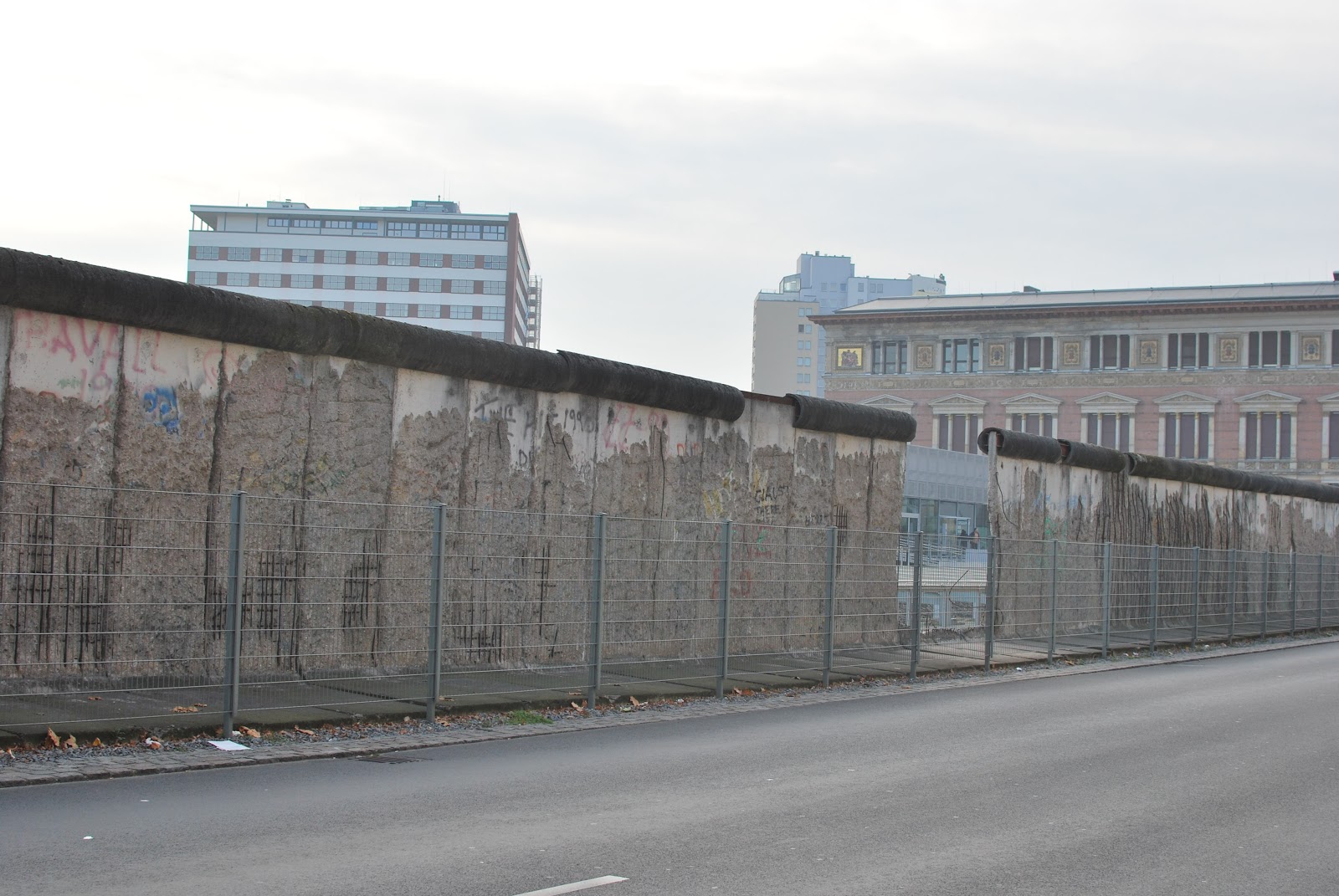
Crumbling remains of the Berlin Wall

Overly popular Checkpoint Charlie

After meeting a few blocks from our hotel at the Hackescher Markt S-bahn station, our guide Jessica led us through the city past dozens of Berlin's most interesting attractions including Museum Island, the Brandenburg Gate, the Berlin Wall, and Checkpoint Charlie. In addition, we were provided with an in-depth history of the city and interesting facts about the years under Nazi control, World War II, the Cold War, and the years since the collapse of the wall.

Altes Museum

Brandenburg Gate

Holocaust Memorial

Christmas Market in Gendarmenmarkt

Despite our reservations about guided tours, the 'Original Berlin' walking tour exceeded our expectations, provided a great introduction to the city, and was very affordable. There are a number of reputable operators offering a range of guided walks which all sounded extremely interesting (and one of which we did - but more about that later). We'd highly recommend a tour like this upon arriving in the city. In fact, we've actually looked for similar tours to join in our next cities, Brussels and Paris; however, neither has the variety of tours or reasonable prices that Berlin offers. 

By Unknown with No comments

Hey there!

Calli and Travis returned from a four month trip through Europe more excited than ever to hit the open road. Who knows where they'll end up next...

  • Popular
  • Categories
  • Archives