Showing posts with label Montenegro. Show all posts

Wednesday, January 23, 2013

Travis Eats His Way Through Europe (Part 2 - The Adriatic Coast)

For the second installment of "reading about, looking at pictures, and becoming insanely jealous of the various foods we ate in Europe" I have decided to write about the food we consumed while traveling along the Adriatic Coast - namely in Montenegro and Croatia.

While I was fairly familiar with the cuisine we encountered in Greece, I really had no idea what to expect in Montenegro and Croatia. I thought (and Calli hoped) that it might be similar to Greek food (it wasn't) or Italian food (kind of...I guess), however in the end we found an abundance of fresh fish and local favorites to fill our bellies.

Italian inspired dishes with local twists are very common.

As you may expect, given the locations we traveled to (mainly along the coast), Croatian and Montenegrin cuisine revolves extensively around the fresh daily seafood catch from the Adriatic. Squid and octopus, mussels and clams, and fish of all imaginable shapes and size are featured on menus everywhere. 


Fried squids and grilled fish at Buffet Fife in Split

Being from British Columbia, we are definitely seafood lovers and took every available opportunity to try the local variations, including Dalmatian fish soup (Dalmatinska riblja juha); fried, deep-fried, and grilled squids; flavourful fish soups; and a wide array of grilled fresh fish. 

Seafood risotto and grilled squids with fresh greens at Cesarica in Kotor
Squids galore at Lokanda Peskarija in Dubrovnik

Our culinary experiences were not limited to seafood,however, and a few of our top food experiences in Croatia and Montenegro came from more traditional inland recipes. Pasticada (a flavourful stewed beef dish often served with hand-rolled gnocchi), fresh local greens known for their immense health benefits (like chard and spinach), and amazing hand-made pastries can be found in traditional konobas - small restaurants that started as wine cellars and are now home to some of the most traditional meals in these two countries. 

Pasticada with gnocchi


Freshly baked traditional pastries

Additionally, we were very surprised at the immense influence that Italian traditions has had on the region. Gnocchi, pizza, and risotto - all with local twists or variations - were found on nearly every menu, and almost all that we tried were very, very good (much better, in fact, than most of what we had in Italy). 

Delicious pizza with fresh local prosciutto

If you are interested in some of our favourite restaurants, we would recommend Dalmatinska Konoba Cesarica in Kotor (wonderful traditional Montenegrin dishes at affordable prices), Lokanda Peskarija in Dubrovnik (great seafood right by the water at very reasonable prices), and Buffet Fife (no website but here is a review) in Split (great traditional Croatian dishes like fish soup and pasticada).


If you missed the last part of this series (or can't remember it because it was months and months ago) you can find it here!

By Unknown with 1 comment

Saturday, October 20, 2012

Half Way Mark

Today, day sixty-one, officially marks the halfway point of our trip. Coincidentally, over breakfast this morning I told Travis I was ready to go home. Awkward. 

Yes, homesickness is starting to set in and honestly it's about time. However I find myself pining more for the convenience of a fridge, my own bathroom, a laundry machine, and some local Fresh is Best taco chips, more so than for family and friends. To any family and friends reading this, please don't be offended, technology (ie. Facebook) does a great job of keeping me apprised of your every move to the point that I still feel in touch. Also, please do some more exciting things, your status updates are becoming a bit passe. 

As we have officially survived two months of travel without running home, ending up in hospital, or killing each other (touch wood), we decided to celebrate and re-live some of our favorite moments thus far.


We failed to foresee any problems with catching a game on the night of our arrival in London - after a nine hour flight and significant time change. However Travis was able to fulfill a childhood dream, making it all worth while. And hey, the home team won!


Reading Festival - Performance by Of Monsters and Men
There were plenty of amazing performances at the Reading Music Festival this year, however Of Monsters and Men blew us away, and has definitely taken over our iPods since. If you haven't heard of them please go download their album right now - seriously, we'll wait. 

runner up - Florence + the Machine, playing in the pouring rain. It was worth getting completely drenched


A bit surreal at times, it was difficult to grasp that I was actually standing on the Ancient Acropolis. After years spent daydreaming about getting there, I walked through in a bit of a fog, stopping every three feet to take another picture. Not until I was able to step back and see the site from afar did it start to sink in. I've been to the Acropolis.


In a surprise move, Nafplio stole top spot as our favorite place in Greece. Welcoming and quiet yet offering plenty to do, with amazing food and accommodations, we were sad to leave and only wish we lived closer to make weekend trips to this amazing city possible. 


Thunderstorms in Kotor
Our last day in Kotor it rained, and not just a little bit. I've honestly never heard thunder that loud, echoing off the stone fortifications it felt as though the storm was directly on top of us. Not to mention the rain, sheets of big fat raindrops puddling ankle deep on the cobblestone streets. The police shut down streets for fear of mudslides and the runoff left a lasting impression on the bay where the water level rose considerably.


Croatia has so much to offer and Travis and I agree that it deserves another visit in the future. In particular, we were blown away by the history in Dubrovnik and the chance to explore war torn Hotel Belvedere. It isn't often that the opportunity presents itself to get off the beaten path in an area seemingly overrun with throngs of cruise ship passengers, however this is exactly what our trip to Hotel Belvedere offered, only fifteen minutes from the ancient walled city.
The perfect end to an amazing run in Croatia, Zagreb's historic centre blew us away with pastel buildings and ornate architecture. Although one day allowed us to cover the highlights, it would be easy to spend two or three and the city has definitely become a must see for us in Croatia.


Cordoba's Mezquita
Thirty minutes into exploring this ancient religious site Travis and I looked at each other and whispered simultaneously "this is the most impressive building I have ever been in". A seamless combination of red and white Moorish arches, Baroque, Gothic, and Renaissance Christian church, and thousands of years of history. Keep an eye out for our upcoming post.  


Self explanatory to an extent, we have filled our bellies with some amazing meals in Europe thus far and only plan to continue that trend moving forward. Although top foodie award has to go to Travis, I've picked my fair share of great restaurants including a memorable Thai restaurant in Barcelona (who knew?). Absolute top meals to date include grilled squids in Kotor, Pasticada in Split, and Piri Piri chicken in Lisbon.

By Unknown with No comments

Wednesday, September 19, 2012

A Daytrip to Perast

Other than the amazing medieval cityscape, the awe-inspiring city walls and fortifications, and the stunning scenery surrounding it, Kotor also serves as a perfect base from which to explore the other interesting locations Montenegro has to offer. On our third day there we decided to do just this, so we packed the backpack with some extra water and the camera and headed off in search of a bus that could take us there.

A map of the Bay of Kotor (via)
As Perast is a small town, none of the passing buses had it as a destination on their front window, and we were unsure if we could just flag down a bus and then request it let us off once we were passing through the city. It turns out that we could of. But we didn't. Not yet anyways. Instead we made the 3 minute trek to the main bus station (look for Autobusni Kolodvar signs...or just follow the stream of countless buses).

We bought our tickets from the lady at the counter (but buying them on the bus is just fine too) for 3 euro each and hopped on. After just a few minutes it took off and we began barrelling our way along the twisty coastal road towards Perast. As we hurtled along the narrow strip of pavement, mopeds and motorbikes flew around us like it was no big deal, buses passed us going the opposite direction with just inches to spare, and all the while the driver spotted people flagging the bus down along the side of the road while simultaneously smoking and talking on his cell phone. He even passed another bus using the oncoming lane. On a blind corner. I decided that looking out the front window was a poor choice, and just reveled at the passing scenery instead.

It turns out that, surprise, our bus driver was not that great. Although we had asked him if this bus stopped in Perast, and he had confirmed that it did indeed, he flew past the town on the highway, not bothering to go through the town center. We were confused. After a quick conference with each other in our seat, we decided we should get off at the next stop as we were quickly traveling further and further from our desired destination. We got off and looked around. We were in  Risan, the next city past Perast.

After a bit of an argument over how we should procede, we decided to walk to what looked like the bus stop and wait for a passing bus to flag down. After a few minutes a large bus came by and we flagged it down...and it stopped! We hopped on and gave the driver 3 euros and kept a close eye on the road. It didn't matter, the bus assistant (I don't know what else to call him) said Perast was the next stop and we pulled into town. We got off the bus and were finally in Perast.

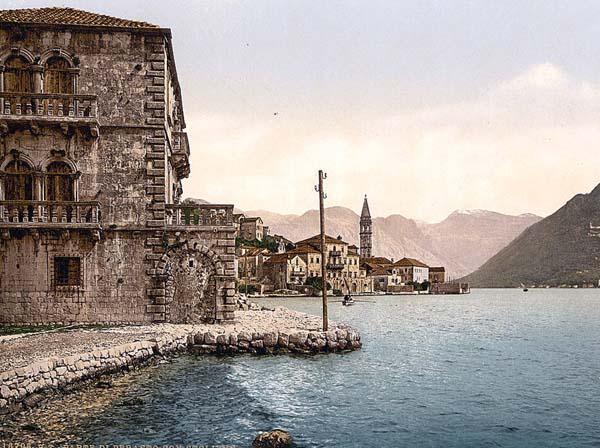
A postcard of Perast in 1900 (via)
 Perast is a small town built along the beautiful Bay of Kotor and is part of the UNESCO Wold Heritage Site called the Natural and Culturo-Historical Region of Kotor. And for good reason. The city was owned by the mighty Republic of Venice as part of Venetian Albania from 1420 to 179. During this time the Venetians built 17 Catholic churches, 16 baroque palaces, 9 defensive towers, and 2 Orthodox churches - all in a city of just 1643 residents at its peak. In addition, two islands sit out in the bay just a few hundred metres from the town, both with picturesque chapels on them.

The postcard-worthy promenade in Perast

Perast from above
An example of the beautiful houses in Perast
We strolled into town via its one real street, a narrow boulevard running along the water with houses and churches in the classical Venetian style on one side, and docked boats and people swimming from the rocky shoreline along the other. Walking the length of the city takes only about 10 minutes at a leisurely pace, but much longer when stopping to admire the architecture and snapping countless photos. But perhaps the best part of Perast is wandering up and down the signless paths that criss-cross through driveways, yards, and past centuries-old buildings just dripping with a mysterious sense of history.


One of the pathways we took.

The classic architecture in Perast

Calli has a door fetish

One of the few cars we saw in the city, you don't really need one.
Today Perast is a far cry from days past. It no longer holds a fleet of 100 boats. Many of the buildings have been deserted as the people slowly left following the earthquakes, occupations, wars, and recessions. The population is down to just 360 at last count (that's around 19 people per church). But the people are still vigorously proud of their heritage. Unused buildings and churches hold small museums, shiny plaques and informational displays celebrate their pride over being the last city of the Republic of Venice to surrender, several months after the republic had fallen.

The main Church in town, St. Nicolas, and its belfry

The massive fleet of days past is long gone
 To end our day we made the short trip to the only man-made island in the Bay of Kotor to visit the appropriately named Gospa od Å krpjela, or Our Lady of the Rocks. The 3030 square meter island was reportedly created by seamen keeping an ancient oath after finding an icon of the Madonna and Child on a rock. After they returned unharmed from each voyage, they would throw a rock in that place until the island reportedly emerged from the bay. Despite the story, it was actually created by the sinking of seized and retired boats filled with rocks further enhanced by dumping large rocks in the area. The people of Perast are very proud of the island even to this day, and, on the sunset of every July 22nd the celebration of faÅ¡inada occurs and the residents all travel out and throw rocks into the water surrounding the island making it even bigger (maybe modern Venetians should adopt this practice).

The man-made island with Gospa od Å krpjela

Travis gazing at The Island of  St. George...swimming there is illegal!
The first church on the island was an Orthodox church built in 1452, but it was subsequently change to the present-day Catholic church Our Lady of the Rocks in 1632. The church interior is worth the trip itself. It is filled with 68 beautiful paintings by famous baroque painter Tripo Kokolja, countless silver votives, and a famous votive tapestry of gold fibres, silver fibres, and hair by Jacinta Kunić-Mijović which took 25 years to complete as she waited for her lover to return from sea (she had gone blind by the time she was finishing it.)


Inscription on the doors of the church
The interior of the church is even more beautiful than the outside
The round trip ticket only cost us 5 euros each and we got to spend as much time as possible. We heard that going to the nearby island of St. George, which holds a 12th century Benedictine Monastery, was also possible, but we were running out of time.

The bus trip back to Kotor was extremely easy, and we felt like Montenegrin bus system pros by the end of it. Exhausted and hungry, we made a quick stop at the grocery store and headed back to our lovely place at Villa Ivana for some delicious gnocchi and fresh bakery bread.


By Unknown with No comments

Monday, September 17, 2012

Climbing Kotor's Fortifications

Our apologies for the delay in writing, we've been swept up exploring Dubrovnik - it's clear now that travel is our first priority. 

We encountered a couple rainy days at the end of our stay in Kotor and once everything dried up we were eager to get outside again. Unfortunately the rain turned our kayak day into a rest day but with a few more coastal stops in the near future I'm sure we'll get on the water yet. 

Sandwiched between two rainy days was a full day of sunshine, which we put to good use by climbing the fortifications nearly one thousand feet (280 meters to be exact) up the mountainside behind Old Town Kotor. At the top stands San Giovanni Fortress, the remains of an ancient castle that would have been one of the most strategic parts of the town's fortification system. Although a significant portion of the fortifications and the fortress were damaged by earthquakes (most recently in 1979), steps are being taken to restore the site and it still reigns as the best views you'll find of Old Town.

Kotor's Stone Walls

Looking out over Kotor from the fortifications

The remains of one of Kotor's many bastions

For our moms - it wasn't really that dangerous

More ruins along the pathway

Triangular Kotor 280 meters below

One lucky lady that seems untouched by years of siege, by both ancient armies and mother nature, is the Church of Our Lady of Remedy. Sitting about a third of the way up the mountainside, and dating back to 1518, the bell tower still stands tall, overlooking the bay and offering some great photo opportunities.

Church of Our Lady of Remedy

Side profile of the fortifications

The amazing view from the fortification walls

A maze of walls, bastions, and pathways with Kotor far below

The hike isn't an easy one, as many of the pathways are still a work in progress, however the views at the top are more than enough reward. Overall we spent about two hours exploring the different bastions, viewpoints, and the fortress, however the hike itself is only about 30 minutes to the top. There are two entrances along the back wall of the city which are easily marked (we took the entrance closest to the North Gate behind St. Mary's Church) and the entrance fee is 3 Euro per person. 


*Disclaimer: Rain in Kotor is a bit more severe than at home, and the walled city doesn't help the situation as the water has nowhere to go. We weren't chicken to get a little wet, we ran to the grocery store to stock up on provisions, only to have to shop completely drenched and have the bakery clerk laugh at us in Montenegrin - she thought I didn't understand but the pointing gave it away. 

Water rushing down the steps in Kotor

By Unknown with 2 comments

Friday, September 14, 2012

Kotor - Life Inside the Walls

When Travis suggested adding Montenegro to our itinerary I quickly agreed, knowing it would count as time outside the Schengen Zone and allow us to extend our trip; however, I didn't know much about the country. As we were slotting it in between Greece and Croatia, I assumed it was along the Adriatic Coast but couldn't pin-point it on a map. Once we started telling friends and family about our trip I could tell I wasn't the only one unsure about this part of the world. Since visiting here's what I've learned:

Montenegro is bordered by Croatia, Bosnia and Herzegovina, Serbia, Kosovo, and Albania. In Ancient times and the Middle Ages the area was passed around by the Romans, Byzantines, Ottomans, Venetians, and everyone in between. In more recent history, Montenegro was part of Yugoslavia before becoming Serbia and Montenegro in 2003. The region struggled through the 1990s during the Bosnian War, Croatian War, and later the Kosovo War. Fortunately, a decade later, it appears as though tourism is once again picking up as visitors recognize all that this area has to offer. Montenegro is currently an independent democracy, member of the UN, and official candidate for membership in the European Union and NATO.

(via)

We decided to focus our visit around the Bay of Kotor, with the Old Town of Kotor, a UNESCO World Heritage Site, serving as our base. As a fortress during the Middle Ages, stone walls have surrounded the city for over a thousand years, seven times longer than Canada has been a country. These stone fortifications make for a unique visit, transporting you back in time and creating a castle-like atmosphere. 


Entrance to the old town is through one of three main archway - the only break in the fortifications which stand 20 meters high, are between 2 and 16 meters thick at times, and even stretch 4.5 kilometers above the city to the castle of San Giovanni. The ancient buildings within the walls run together, standing three or four stories tall to make up for the lack of space. The narrow cobblestone streets are a maze, winding between buildings and opening into grand church-lined squares; a bit crowded at times with Cruise Ship tour groups, a common theme we are encountering.


Everywhere you look and everything you touch in Kotor is soaked in history. The Guardic Gate, closest to our apartment, boarders a moat and maintains fixtures that would have supported a drawbridge many years ago. In the main square, the double bell towers of St. Tryphon's Cathedral (1166 AD) stand tall as the best known landmark in Kotor. The crumbled remains of the Monastery of St. Francis, constructed in the 17th century, are just outside our bedroom window (if you crane your neck you can make out the bell tower and a circular opening where stained glass may have sat).


Unfortunately the fortified city of Kotor was conquered many times and possession changed hands many times during the Middle Ages. Additionally, it was rocked by Earthquakes in 1563, 1667, and 1979. These periods of turmoil severely damaged many of the buildings, and as a result, some have been rebuilt and repaired many times, as money allowed, while others have fallen into disrepair. However, instead of being an eye sore, these crumbled buildings add to the charm of Kotor, and give a wonderful glimpse at how quickly mother nature can reclaim the land.


As the town is so compact cars cannot enter, adding to the appeal of life inside the walls. Taxis drop passengers off on the main road, a single lane each direction between the marina and the city walls, and from this point on you are on your own to roam the city in search of your accommodations.

By Unknown with No comments

Hey there!

Calli and Travis returned from a four month trip through Europe more excited than ever to hit the open road. Who knows where they'll end up next...

  • Popular
  • Categories
  • Archives