Showing posts with label Athens. Show all posts

Saturday, October 20, 2012

Half Way Mark

Today, day sixty-one, officially marks the halfway point of our trip. Coincidentally, over breakfast this morning I told Travis I was ready to go home. Awkward. 

Yes, homesickness is starting to set in and honestly it's about time. However I find myself pining more for the convenience of a fridge, my own bathroom, a laundry machine, and some local Fresh is Best taco chips, more so than for family and friends. To any family and friends reading this, please don't be offended, technology (ie. Facebook) does a great job of keeping me apprised of your every move to the point that I still feel in touch. Also, please do some more exciting things, your status updates are becoming a bit passe. 

As we have officially survived two months of travel without running home, ending up in hospital, or killing each other (touch wood), we decided to celebrate and re-live some of our favorite moments thus far.


We failed to foresee any problems with catching a game on the night of our arrival in London - after a nine hour flight and significant time change. However Travis was able to fulfill a childhood dream, making it all worth while. And hey, the home team won!


Reading Festival - Performance by Of Monsters and Men
There were plenty of amazing performances at the Reading Music Festival this year, however Of Monsters and Men blew us away, and has definitely taken over our iPods since. If you haven't heard of them please go download their album right now - seriously, we'll wait. 

runner up - Florence + the Machine, playing in the pouring rain. It was worth getting completely drenched. 


A bit surreal at times, it was difficult to grasp that I was actually standing on the Ancient Acropolis. After years spent daydreaming about getting there, I walked through in a bit of a fog, stopping every three feet to take another picture. Not until I was able to step back and see the site from afar did it start to sink in. I've been to the Acropolis.


In a surprise move, Nafplio stole top spot as our favorite place in Greece. Welcoming and quiet yet offering plenty to do, with amazing food and accommodations, we were sad to leave and only wish we lived closer to make weekend trips to this amazing city possible. 


Thunderstorms in Kotor
Our last day in Kotor it rained, and not just a little bit. I've honestly never heard thunder that loud, echoing off the stone fortifications it felt as though the storm was directly on top of us. Not to mention the rain, sheets of big fat raindrops puddling ankle deep on the cobblestone streets. The police shut down streets for fear of mudslides and the runoff left a lasting impression on the bay where the water level rose considerably.


Croatia has so much to offer and Travis and I agree that it deserves another visit in the future. In particular, we were blown away by the history in Dubrovnik and the chance to explore war torn Hotel Belvedere. It isn't often that the opportunity presents itself to get off the beaten path in an area seemingly overrun with throngs of cruise ship passengers, however this is exactly what our trip to Hotel Belvedere offered, only fifteen minutes from the ancient walled city.
The perfect end to an amazing run in Croatia, Zagreb's historic centre blew us away with pastel buildings and ornate architecture. Although one day allowed us to cover the highlights, it would be easy to spend two or three and the city has definitely become a must see for us in Croatia.


Cordoba's Mezquita
Thirty minutes into exploring this ancient religious site Travis and I looked at each other and whispered simultaneously "this is the most impressive building I have ever been in". A seamless combination of red and white Moorish arches, Baroque, Gothic, and Renaissance Christian church, and thousands of years of history. Keep an eye out for our upcoming post.  


Self explanatory to an extent, we have filled our bellies with some amazing meals in Europe thus far and only plan to continue that trend moving forward. Although top foodie award has to go to Travis, I've picked my fair share of great restaurants including a memorable Thai restaurant in Barcelona (who knew?). Absolute top meals to date include grilled squids in Kotor, Pasticada in Split, and Piri Piri chicken in Lisbon.

By Unknown with No comments

Sunday, September 9, 2012

A Journey through Time in Athens (Part 2)

Calli has pointed out that I need to be "making my deadlines", aka she has a Nafplio post written and refuses to post it until I finish up writing about our time in Athens. Since there is (as of today) 103 days left, and she will be with me for most likely all 103 of those days, I figured I had better get a move on. So here goes part 2 of our time in Athens.

After our Acropolis and Acropolis Museum day, we decided that we would go on a modified Rick Steves-inspired, self-guided walking tour of many of the historical sites we didn't have time to see on our first day. We pulled out our handy tourist map (which we found out used seemingly arbitrary distances and directions - but it was free so I guess we got what we paid for) and plotted a course for the day. 

We decided to start our day at the Arch of Hadrian and Temple of Olympian Zeus. These two famous landmarks are located in the same area and are pretty impressive sights.

The Arch of Hadrian

The ruins of the massive Temple of Olympian Zeus
The Arch of Hadrian was built as a monumental gateway into Athens in 131 AD to celebrate the visit of the Roman Emperor Hadrian (who seemingly just traveled around building stuff and having stuff built in his name) and the many donations he contributed to Athens. It was built completely of pentelic marble and used no mortar in its construction. It stands impressively at just under 60 feet tall and has different inscriptions on each side. One saying Athens is the city of Theseus, and the other that Athens is the city of Hadrian (presumably referring to the "old" and "new" parts of Athens respectively).

Some of the amazing detail on the Arch itself
Just a few hundred feet away from the still standing Arch of Hadrian lay the ruins of the Temple of Olympian Zeus. Building this behemoth of a temple, fitting for the king of the Olympian gods, took 638 years of constantly interrupted and constantly changed plans. Unsurprisingly, after many attempts to complete it, it was finally completed under the guidance of that building mogul - Hadrian. Upon its completion it was dedicated to Hadrian and was renowned as the largest temple in Roman Greece. It was destroyed and pillaged during the Barbarian invasion in the 3rd century AD and was never rebuilt. In fact, much of the ruined temple was re-used in other building projects throughout the last 1800 years. Only a small portion still stands, but the immense size of the remaining columns is very impressive still.

We next wandered down the street up the street to the Panathenaic Stadium, best known as the site of the first modern Olympic Games in 1896. 

Opening ceremonies of the 1896 Olympic Games at the Panathenaic Stadium (via)
Originally built in 566 BC with wooden seating, it was rebuilt entirely in white Pentelic marble in 329 BC. During these times it was used for the Panathenaic games, sporting events carried out in honor of the goddess Athena. The stadium was renovated in 1895 to host the first modern version of the Olympic Games in 1896 and could host 80 000 people. It was used once again at the 2004 Athens Olympic Games, and is now a popular and impressive site to visit as was obvious from the countless tour buses lining the street beside it.

The Panathenaic Stadium today (via)
After reveling in sporting history for a few minutes (there seemed to be a cruise ship tour group there and the sun was blazing down on us) we crossed the street for some well-earned time out of the sun in the National Gardens.

One of the pathways in the National Gardens
The National Gardens is a 38 acre oasis in the centre of Athens, and was a welcome relief for our walk. As we entered in front of the Zappeion, the first building built specifically for the revival of the Olympics, the palm-lined entrance and large fountain ushered our way into this different world. People lounged on benches, played on the grass, and generally just enjoyed the cool, fresh air provided by the abundance of vegetation. Nowadays, it seems more like a park than an organized garden as many of the areas have been allowed to grow and fill space freely, but it is still full of plaques denoting important or interesting species and a number of elegant statues and monuments.

The Zappeion, nowadays an important meeting and conference center.
We wandered by their "lake" (in Canada we would call this a pond...maybe), by the statue marking where King Alexander was bitten by a pet monkey and subsequently died from sepsis in 1920, past uncovered ancient antiquies, and finally exited into Syntagma Square.

Syntagma Square is one of the most famous squares in all of Greece. Bordered by chic hotels, expensive cafes, the Tomb of the Unknown Soldier, and Greek Parliament; and holding the entrance to one of the major metro stops right in the middle, it is frenetic blur of mixing Greek society. 

Part of Greek Parliament in Syntagma Square

We wandered through the central part of the square, looking up and trying to figure what the difference between our 40 euro room and the 250 euro rooms above us were. We snapped pictures of the tomb of the unknown soldier complete with soldiers standing guard, and of the parliament building which used to be the royal palace. 

We left the square and began to work our way through Syntagma towards Athens' most famous neighborhood, the Plaka. The neighborhood sits in the shadow of the Acropolis and is filled with regal buildings, counteless museums, and fantastic churches. We stopped for a pastry and a cool drink and sat near one of the old churches watching the people as they went about their days. After looking in some souvenir shops and enjoying a stroll through the narrow vehicle-less streets, we made our way to our last stop of the day.

An example of the neighborhoods near Syntagma and the Plaka

One of the countless ancient churches in Athens
The Lysicrates Choragic monument may not be one that stops you in your tracks, in fact it's pretty easy to miss if you are not looking out for it, but is does have an interesting history. It was erected by the choregos (aka wealthy Athenian) Lysicrates in 335 BC to celebrate the first-prize victory of one of the performances he sponsored. The friezes on the exterior describe the myth of Dionysus, and it stands on the street that once led to the Theater of Dionysus. The street used to be lined with similar choragic monuments. but it seems as though this is the only one that survived  intact. This was probably due to the fact that a French Capuchin monastery was founded on the site in 1669, and the order agreed to purchase the it. They have maintained the structure ever since, and were largely responsible for the spreading of this type of monument throughout the rest of Europe. British architects on tour published drawings of it, Lord Byron described it during his stay in Athens, and Lord Elgin (the marbles guy) tried to purchase it, unsuccessfully, to bring back to England. All of these contributed to replicas popping up all over Europe...London, Paris, Sydney, Nashville, New York, and many others all have their own version of this style of monument. 
The Lysicrates Choragic Monument

Some of the detail on the outside of the monument
After about 7 hours of exploring we wandered back for a quick siesta before dinner, packing, and saying goodbye to Athens.

By Unknown with No comments

Thursday, September 6, 2012

A Journey through Time in Athens (Part 1)

At first glance, Athens seems like a dense, bustling metropolis covered in concrete and graffiti, and filled with repetitive blocks of 8-storey apartment buildings. And it is...for the most part. However, if you look a little closer, the mayhem peels away and you see the city you heard and read about your entire life - a city filled with a history spanning over 7000 years. Like Rome, it's a city where ten year old buildings are beside hundred year old buildings, and hundred year old buildings are beside thousand year old buildings. Our short two-day stay in Athens gave us the opportunity to explore a part, if only a small one, of this storied history.

Old & New - The Temple of Hephaestus (completed in 415 BC) is just a few feet from a modern neighborhood.
On our first day we decided to explore the most famous of Athens' landmarks, the Acropolis. This ancient citadel is one of the world's most famous ancient sites due to the awe-inspiring combination of it's stunning architecture, perfect hill-top location, and interesting history. After paying our 12 euro entrance fee (in our opinion too much, but no more than you would expect) we began slowly making our way though the site. The entrance appeal is fantastic as you approach the Propylaea, the marble entrance to the Acropolis site that allowed those deemed worthy of entrance, you have the beautiful Temple of Athena Nike standing to your right, and the stunning Odeon of Herodes Atticus down below.

An recreation of the Acropolis site during its time of use by Leo von Klenze (via)

The Odeon of Herodes Atticus - Still used today for operas and plays.

The Propylaea - The Gate to the Acropolis

The Temple of Athena Nike fully restored
As you pass through the Propylaea into the center of the centre of the Acropolis site you are greeted by the looming Parthenon, undoubtedly one of the most famous structures in the world. Dedicated to the goddess Athena, the virgin patron of Athens, it took nine years to build and another six years to decorate. Currently, like many of the buildings on the site, it is undergoing careful restoration to ensure its stability for the future. In addition, very little of the decorative friezes, metopes, and pediments remain - some removed by Lord Elgin and his crew, and displayed in the British Museum in London, and the majority of the remaining pieces (that were not destroyed over the ages) displayed in the new Acropolis Museum. None of these factors can take away from the majesty of the building however.

We wandered around the entirety of the building, snapping pictures of the unbelievable architectural features of the building itself, but mostly just being in awe of it. It's sheer size is unbelievable (228 x 101 feet), and the fact that it was built using golden ratios is even more unreal. When you couple the structure with the intricately detailed pieces that would have adorned it on display in the museum, it is easy to understand the reason that millions of people flock to it every year.

The southeast corner of the Parthenon
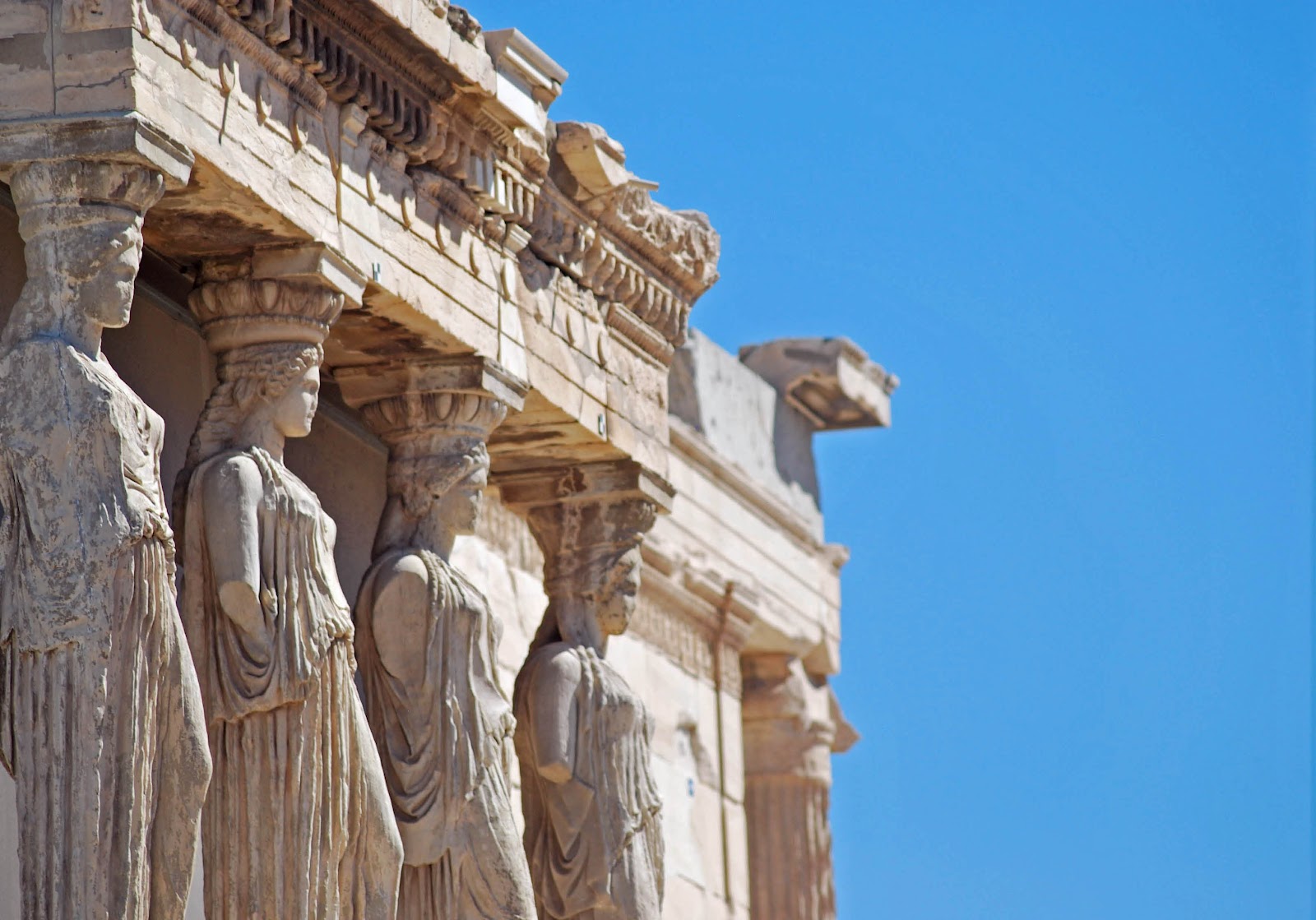
After we eventually moved on past the Parthenon, which wasn't easy to do, we wandered back along the north side of the Acropolis and past the ruined Old Temple of Athena and the still standing Erechtheum. Only the foundation of the Old Temple of Athena survives today, the rest of it being destroyed by invading Persians in 480 BC. The Erechtheum, however, still stands in very good condition even to this day. Originally built between 421 and 406 BC by the sculptor Phidias (the same sculptor that built the Parthenon) and under the supervision of Pericles, it stood as a shrine to the Greek hero Erichthonius. It is a beautiful building capped off by the impressive Porch of the Caryatids, a sculpture of 6 unique women, 4 of which survive today.

The extraordinary detail on the Porch of the Caryatids' figures.
On our way out we decided to utilize our free entry to the Ancient Agora that came with our Acropolis entrance ticket. The Ancient Agora sits below the Acropolis to the north and contains many ruins, as well as a number of extraordinarily preserved buildings. The Ancient Agora represents the best preserved surviving Agora, or gathering place, in Athens. The two best preserved buildings, the Stoa of Attalos and the Temple of Hephaestus, as well as the more contemporary Church of the holy Apostles, were all wonderful to look at.

Built nearly 300 years after the Parthenon, the Stoa of Attalos is perhaps one of the most impressive buildings in all of Athens. It measures 377 feet long and stood until its partial destruction in 267 AD. It was faithfully reconstructed in 1950 to stand as the Ancient Agora Museum. Today its open areas are filled with beautiful examples of Greek sculptures.

One of the beautiful examples of the sculptures on display at the Stoa of Attalos

The outer columns of the Stoa of Attalos
The Temple of Hephaestus is generally regarded as the best preserved ancient Greek temple. Completed in 415 BC, it still stands largely as built, with only minor damage sustained over the ages. it is surrounded by a beautiful little garden filled with pomegranates and functioned as a Greek orthodox church for much of its history.

The surrounding garden provides a gorgeous setting for the Temple of Hephaestus

The well-preserved exterior of the Temple of Hephaestus
The final major building in the Ancient Agora is also the newest. The Church of the Holy Apostles dates back over a thousand years, and is one of the first churches to be built in what would be referred to as the "Athenian" style. It apparently has some amazing paintings and artwork still inside, but was chained up when we were there.

The Church of the Holy Apostles
After wandering around in the devastating Athens sun for the better part of 5 hours, we were in desperate need of some time in the shade, and the newly built Acropolis Museum provided just that. As you make your way towards the entrance, the clear plexiglass walkways allowed us to peer down to current excavations going on just below the museum. After paying our 5 euro entrance fee and checking our bag, we began wandering aimlessly around the ultra-modern new facility, admiring all of the amazing pieces from the Acropolis site that survived the merciless weather and seemingly constant invasions.

The entrance to the new Acropolis Museum with its plexiglass walkways.
Many of the sculptures and statues have only fragments remaining, and some have been reconstructed using plaster with the original pieces incorporated. Many amazing examples of pottery and sculptures remain fully intact, and all of the pieces are cataloged and described in detail.

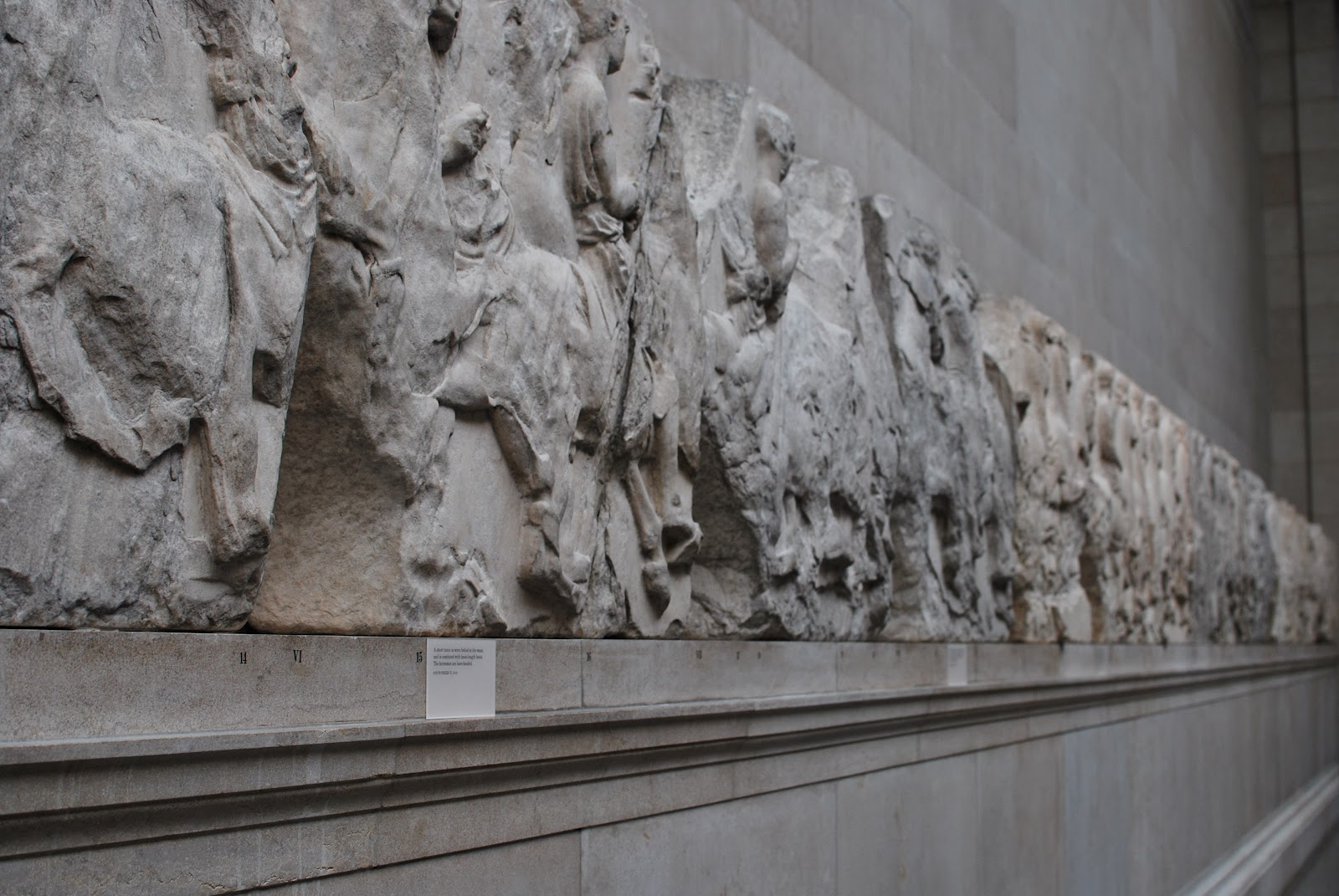
The piece de resistance, however is the upper floor, the floor housing the Parthenon marbles. The marbles are organized as they would have been when in the actual Parthenon, incorporating actual pieces owned by the museum and casts of those found in the British Museum. Much controversy exists with regard to the so-called "Elgin Marbles" on display at the British Museum. These pieces were removed by Thomas Bruce, the British Ambassador to the Ottoman Empire from 1801 to 1812. They represent just under 50 % of the marbles from the Parthenon and have been on permanent display in the British Museum since 1816. The British museum argues that they have been on display free to the public (unlike the Acropolis Museum) and also survived much better than those left behind. Greece has continuously argued for their return but has been unsuccessful so far. In any case, we thoroughly enjoy both exhibits.

An example of the mixing of original marbles from the Acropolis Museum and plaster casts from the British Museum

The fantastic display at the Acropolis Museum

The display of the "Elgin Marbles" at the British Museum

Some of the well-preserved pieces at the British Museum
Finally, exhausted, we returned for some food and a well-earned sleep.

By Unknown with 1 comment

Tuesday, September 4, 2012

Athens - Bursting At the Seams

We weren't entirely sure what to expect upon arrival in Athens, after Santorini won us over with it's beauty and hominess, would we enjoy our time in Athens or regret leaving the island too soon? 

From the Acropolis - The never ending city

As a major metropolis, Athens is fast moving, loud, and large; while we explored Santorini by ATV only days before, we now pitied our Athens cab driver and the mind boggling traffic he had to endure on a daily basis. The city seems never ending, a continuation of concrete apartment buildings, honking horns, and crowded streets stretching forever. At ground level, a canopy of apartment buildings, their balconies crowded with potted plants, loom overhead, filtering the harsh sunlight but somehow failing to stop the heat from reaching the pedestrians below. Although overcrowded with people, automobiles, and large garbage bins (that permanently sit on the curb for all to use), we discovered that there are places of refuge, in a city apparently bursting at the seams.

Street view - cars and apartment buildings

The "Lake" at the National Garden

One of our favorite places to rest, refuel, and people watch, was Ambrosia Restaurant, a few blocks from our hotel. Situated on the outskirts of a small tree-lined square, we were able to cool down in the shade of a palm tree and feast on homemade Greek gyros, moussaka, and tzatziki for less than 15 Euro. The food, atmosphere, and service was so good we didn't bother finding another restaurant after our first meal the evening of our arrival - we returned twice, on our second and third days in the city, and it was delicious each visit. 

Time to dig in at Ambrosia Restaurant


A visit to the National Garden, during a self-led walking tour on our second day in Athens, also provided an injection of some much needed green space. The garden is 15.5 hectares in size and features a small lake, convention centre and fountain, bench-lined pathways, and some of the largest palm trees I've ever seen. Overall it's quite lush and a lovely refuge in the middle of the city. 

The National Garden

While we aren't sure we could last, let alone thrive, in a city as expansive as Athens, two days was the perfect amount of time to fully explore the Acropolis and ancient sites, as well as the Old Quarters of Plaka and Monastiraki. Athens may have little in common with the beauty and calm of Santorini, however the people have proven to be helpful and inviting regardless of which city they call home, and I expect nothing less in our last Greek stop, Nafplio.


By Unknown with No comments

Hey there!

Calli and Travis returned from a four month trip through Europe more excited than ever to hit the open road. Who knows where they'll end up next...

  • Popular
  • Categories
  • Archives