Showing posts with label Fortifications. Show all posts

Saturday, November 3, 2012

Our day at the Alhambra of Granada

As part palatial opulence, part crumbling fortress of a bygone era, and part spectacular water gardens, the Alhambra of Granada exemplifies the pinnacle of former Moorish power in modern day Andalucia, and is undoubtedly one of the most important architectural sites in the whole of Europe. Most certainly the main reason that millions of tourists flock to Granada every year (although it would be worth it by itself in our opinion), we knew that we just had to go there...and so we did. But there were a few bumps along the way...

Part of the fortifications of the Alhambra from the outside

Calli - "It was only a matter of time before one of us caught a bug."

After a few migraines and an initial week of cold/congestion in London (the result of rain one night at the Reading Music Festival), I was sidelined for a day in Granada by a flu-like bug. After whining and complaining and apologizing over and over about ruining the day I decided there was nothing left to do but sleep and sent Travis off to explore on his own (he returned a couple hours later with lunch, so sweet!).

Unfortunately colds and flus don't stop while traveling, and can often be more common due to little sleep and poor diet. Although the cure is often simple - rest - slowing down for a day or two can be frustrating. With two days in Granada I was not prepared to spend both in bed and miss out on the Alhambra, especially considering the complex advanced booking system. We had our day and entry time and it was non-negotiable.


The Alhambra

A bit tired, somewhat sluggish, and very cranky, we made our way to the Alhambra early in the afternoon for our 2pm entry time. Surprisingly, for a site so busy, we barely noticed the droves of tour buses parked outside the gates. Instead, we were immediately entranced by the sounds of the nightingales that call the park home and the smells of the seemingly endless roses, myrtles, and oranges.

The view from the Alhambra towards Sacromonte and the Albayzin

The entrance took a few frustrating minutes to negotiate (it seemed like the most incompetent people ever to travel to Spain were in front of us...isn't that always the case), but once we were in it was a proverbial festival for the senses. 

The Alhambra site as it stands today can be roughly separated into 4 parts - the Generalife, the Alcazaba, the Palace of Charles V, and the Nasrid Palace.

The Generalife are the former gardens that surround the fortress, palace, and other buildings. They Palace located in the gardens and the gardens themselves were a getaway place for the royalty, as well as a place for the public to grow fruits and vegetables. Elegant water features, perfectly manicured gardens, and fantastic views abound here.


A view of the Generalife and its beautiful manicured gardens


The Alcazaba is the former citadel and oldest part of the complex. While some of it has crumbled from earthquakes and neglect over the years, the outer walls, towers, and ramparts still stand and make it an imposing presence even to this day. The main tower offers fantastic panoramic views of the entire city and its surrounds.


One of the Towers of the Alcazaba, with Granada Cathedral in the distance

The remains of the interior of the Alcazaba


The Palace of Charles the V was a late addition to the site. Built by, you guessed it, Charles V, the Rennaisance architecture is a striking juxtaposition to the rest of the site, but it is definitely worth a visit. Apparently the round central patio acts has perfect sound amplification at its center. 

The rectangular exterior of the Palace of Charles V

The round patio in the center of the Palace of Charles V


The Nasrid Palace is the crowning jewel of the Alhambra. Built for the last Emirs of Spain as the rest of al-andalus was being reconquered, it represents the greatest example of Mujedar architecture in Spain. Deceptively drab from the exterior, the interior is an architectural gem with scripture from the Koran adorning the walls, intricate tessellations (that inspired M.C. Escher), and ornate stalactite ceilings. 

Patio de los Arrayanes (The Court of the Myrtles)

The detailed decorations are amazing

One of our favorites - the ceiling looked like the starry sky

Detailed wall carvings

Patio de los leones (Patio of the Lions)

The exteriors of the buildings were intentionally drab


We thoroughly enjoyed our visit to the Alhambra, even while jockeying for position to take photos among the droves of other tourists. The site as a whole is very extensive, an incredible deal for the 13 Euro price tag, and reason enough to visit Granada.

By Unknown with No comments

Saturday, October 20, 2012

Half Way Mark

Today, day sixty-one, officially marks the halfway point of our trip. Coincidentally, over breakfast this morning I told Travis I was ready to go home. Awkward. 

Yes, homesickness is starting to set in and honestly it's about time. However I find myself pining more for the convenience of a fridge, my own bathroom, a laundry machine, and some local Fresh is Best taco chips, more so than for family and friends. To any family and friends reading this, please don't be offended, technology (ie. Facebook) does a great job of keeping me apprised of your every move to the point that I still feel in touch. Also, please do some more exciting things, your status updates are becoming a bit passe. 

As we have officially survived two months of travel without running home, ending up in hospital, or killing each other (touch wood), we decided to celebrate and re-live some of our favorite moments thus far.


We failed to foresee any problems with catching a game on the night of our arrival in London - after a nine hour flight and significant time change. However Travis was able to fulfill a childhood dream, making it all worth while. And hey, the home team won!


Reading Festival - Performance by Of Monsters and Men
There were plenty of amazing performances at the Reading Music Festival this year, however Of Monsters and Men blew us away, and has definitely taken over our iPods since. If you haven't heard of them please go download their album right now - seriously, we'll wait. 

runner up - Florence + the Machine, playing in the pouring rain. It was worth getting completely drenched


A bit surreal at times, it was difficult to grasp that I was actually standing on the Ancient Acropolis. After years spent daydreaming about getting there, I walked through in a bit of a fog, stopping every three feet to take another picture. Not until I was able to step back and see the site from afar did it start to sink in. I've been to the Acropolis.


In a surprise move, Nafplio stole top spot as our favorite place in Greece. Welcoming and quiet yet offering plenty to do, with amazing food and accommodations, we were sad to leave and only wish we lived closer to make weekend trips to this amazing city possible. 


Thunderstorms in Kotor
Our last day in Kotor it rained, and not just a little bit. I've honestly never heard thunder that loud, echoing off the stone fortifications it felt as though the storm was directly on top of us. Not to mention the rain, sheets of big fat raindrops puddling ankle deep on the cobblestone streets. The police shut down streets for fear of mudslides and the runoff left a lasting impression on the bay where the water level rose considerably.


Croatia has so much to offer and Travis and I agree that it deserves another visit in the future. In particular, we were blown away by the history in Dubrovnik and the chance to explore war torn Hotel Belvedere. It isn't often that the opportunity presents itself to get off the beaten path in an area seemingly overrun with throngs of cruise ship passengers, however this is exactly what our trip to Hotel Belvedere offered, only fifteen minutes from the ancient walled city.
The perfect end to an amazing run in Croatia, Zagreb's historic centre blew us away with pastel buildings and ornate architecture. Although one day allowed us to cover the highlights, it would be easy to spend two or three and the city has definitely become a must see for us in Croatia.


Cordoba's Mezquita
Thirty minutes into exploring this ancient religious site Travis and I looked at each other and whispered simultaneously "this is the most impressive building I have ever been in". A seamless combination of red and white Moorish arches, Baroque, Gothic, and Renaissance Christian church, and thousands of years of history. Keep an eye out for our upcoming post.  


Self explanatory to an extent, we have filled our bellies with some amazing meals in Europe thus far and only plan to continue that trend moving forward. Although top foodie award has to go to Travis, I've picked my fair share of great restaurants including a memorable Thai restaurant in Barcelona (who knew?). Absolute top meals to date include grilled squids in Kotor, Pasticada in Split, and Piri Piri chicken in Lisbon.

By Unknown with No comments

Monday, October 15, 2012

Toledo Daytrip - Cathedrals, Art, and a Train Station

If you've had a chance to read up on our day trip to Segovia. you are already aware that we also decided to visit Toledo during our time in Madrid. If you weren't aware, sorry to have ruined the surprise.

We arrived in Toledo mid morning and were immediately impressed as our train pulled into the station. Our first real taste of Moorish inspired architecture, the station's brick facade is rivaled only by it's intricately tiled interior complete with original wood carved ticket windows and stained glass. 

Exterior with clock tower

Carved wood ticket counter and tile floors

Tiles walls, arched windows, and stained glass


Upon exiting the station we were met by the regular row of taxis and open-top tour buses offering transportation for 6-10 Euros. Although more affordable than most transportation offers we've encountered, being frugal and fit we chose to start walking and see where we ended up. The choice was a good one, as Toledo is only about 5 minutes be foot from the train station (albeit uphill), and the walk offers some great views of the city walls and the Tagus River. 

City walls and Alcazar

Bridged entryway

We spent a few hours exploring the narrow streets before stumbling onto the Cathedral, where a zumba group of about 250 people was part way through their workout routine in the main square. With techno blaring from the surprisingly large speakers, it was quite a sight to see tourists, old and young, joining in on the fun. All the commotion made entering the Cathedral a bit of an ordeal; however, once inside we found solitude, with only the faint rhythm of some Coldplay drifting through the main doors. 

The interior was impressive, an over-the-top gold alterpiece with multiple floor to ceiling organs as well as a second, ornately carved and painted Baroque alterpiece, all surrounded by richly decorated chapels. In addition to the stunning alters, the Cathedral features a small museum of original paintings, with multiple notable works by El Greco. 

Gilded Cathedral Alter

Exterior steeple

Smaller gated entry

Toledo had a lot to live up to after our jaw dropping visit to Segovia the day before, and perhaps our expectations were unfairly high as we felt a bit let down in the end. However, it's worth noting that Toledo also offers an Alcazar and many other churches to explore, we simply chose not to part with our hard earned Euros for a glimpse inside. Overall, both cities complimented each other well, but if we only had one day we'd head for Segovia. 


*A reminder, we post our full photo sets on Flickr, often thirty or more photos - accessible at the photo tab atop this page!

By Unknown with No comments

Thursday, September 27, 2012

Trogir, Getting There is Half the Fun

One of the places on our must-see list of daytrips was the UNESCO World Heritage site of the historic centre of Trogir. Just a one-hour boat or bus ride away from Split, Trogir is widely regarded as the best-preserved example of a Romanesque-Gothic historic center in all of central Europe. With this in mind, we decided that Trogir would be well worth a day of exploring and set out from Split on our second day there. 

Trogir from the water - the bridge opens up to let boats pass

We decided that taking a boat to Trogir would provide a different view of the area, so we set off for the harbour and hopped on the small boat that ferries tourists and locals alike to and from Trogir. What we had forgotten, however, was that there had been a huge thunderstorm the previous night, in turn it had made the seas a bit rough. Well, more like very rough. Despite the waves, causing the boat to involuntarily replicate the Indiana Jones ride at Disneyland, it proceeded to chug along and eventually we made it to Trogir.

During a moment of calmness we snapped a photo of the boat

As we left the boat and regained our land legs, the view towards the historic centre made it quickly apparent why Trogir was inducted as a UNESCO World Heritage site in 1997. The city has been continuously lived in for over 2300 years, and its core is a blending of Greek, Venetian, and Roman influences. The historic city center is actually an island, separated from the island of Ciovo and the mainland by narrow bridged canals.

Lovely sail boat docked in the canal

Palm trees along the promenade

Kamerlengo Fortress along the canal

The city is like a postcard. An expansive palm-lined promenade allows tourists and locals to enjoy a cappuccino while gazing enviously at the million dollar yachts tied up along the canal. 15th century walls surround much of the city with the magnificent 17th century city gate allowing the droves of visitors to enter after enjoying said cappuccinos. Churches and palaces ranging from the 13th to 15th centuries, many still with the original coat of arms of the families who once resided there, enchant the imagination with their stunning architectural features. An finally, the Cathedral of St. Lawrence caps it all off. The massive structure took hundreds of years to complete, a fact which is evident in the mixing of styles of the Romanesque-Gothic basilica. What really makes the area really special however, is the portal on the west entry, a masterpiece of art by famous Croatian sculptor Master Radovan.

The entire city could be explored in just a few hours, but spending some time getting lost and finding hidden treasures in the winding back streets makes it a more rewarding experience. We wandered around looking in shops, exploring the narrow streets, and snapping hundreds of pictures. 

Some hidden gems down the streets of Trogir

Coat of Arms still remains on this home

Cathedral of St. Lawrence
On our way back to the dock to catch the boat home, we discovered that the waves and wind were preventing the company from running the ferry. We were informed that we should probably take the bus instead. We made the short walk over to the bus station and caught the city bus into town. It took about an hour and was a fairly comfortable ride, although less scenic that the boat. 

We thoroughly enjoyed our trip to Trogir and would recommend it to anyone visiting Split, or Croatia for that matter. It was also a fabulous day for taking photos, more can be seen on our Flickr page (just click on the "photos" link on the top menu bar).

By Unknown with No comments

Tuesday, September 25, 2012

Split - Just Another Walled City?

As our journey through Croatia continued, we found ourselves in Split - yet another charming city full of history and ancient stone architecture. However it turns out that Split is actually very different from Kotor, Perast, Dubrovnik, and even Trogir (a neighbour one hour away we visited by day trip).

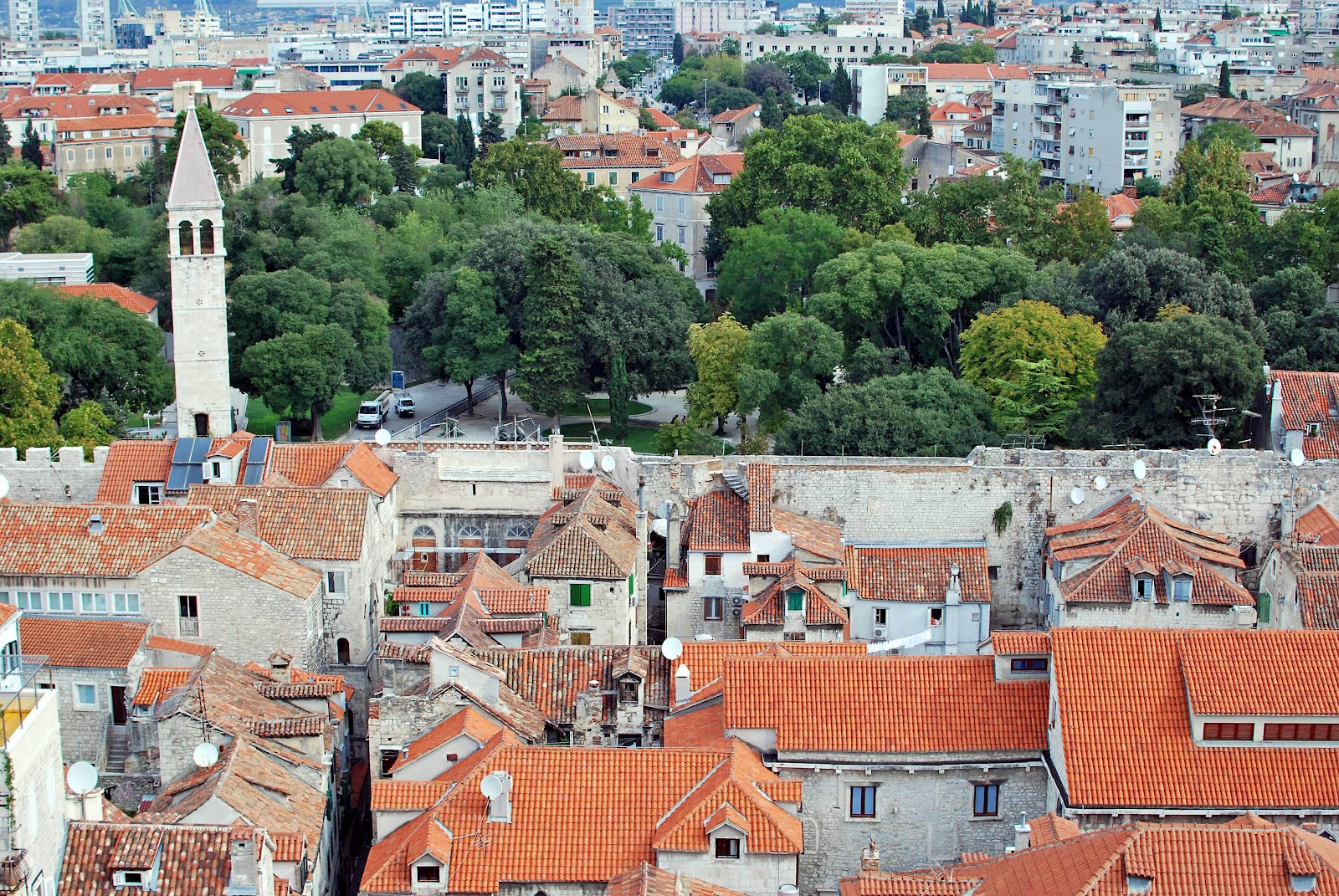
Old Town walls in Split - view from the cathedral belltower

Illustration of Diocletian's Palace, Paris 1912 (via)

Initially constructed in preparation for Roman Emperor Diocletian's retirement  in 305 AD, Diocletian's Palace was more a luxurious villa/military camp  than a palace. Complete with a main square, public and private apartments, and various religious buildings including a cathedral and mausoleum, the rectangular palace was surrounded by huge gates and watchtowers. After being abandoned by the Romans, the palace sat empty until the 7th century when nearby residents sought refuge there from invading barbarians. It has been occupied ever since and is now one of the most famous and complete remains of a Roman Palace.

Perhaps what sets Split apart from many of the other fortified cities along the Adriatic coastline that we've visited lately, is the way in which the more modern city has swallowed up the ancient historic centre. Unprotected as an official heritage site until 1979, urban development pushed up around Diocletian's Palace before breaching the gates and spilling onto the worn stone streets. 

Sphinx in the main square - 3 of the original 13 still exist in Split

Entrance gate on the East end of Old Town

Stone buildings in Old Town Split

Local produce at the daily outdoor market

As a result, modern storefronts and family dwellings stand in contrast with Roman architecture dating back thousands of years, often covering or replacing it completely. The result is a Frankenstein-esque aesthetic and unique atmosphere where Lacoste clothing stores compete with ornate cathedral belltowers for the attention of the tourist hoards on a daily basis.

It's unfortunate that it's so difficult to decipher where the ancient sites once stood. From the top of the belltower of the Cathedral of St. Duje, it is possible to make out a few stretches of stone fortification still intact, however don't look away, the buildings on each side tend to blend together and with just a blink of the eye the portion of wall you spotted moments earlier has disappeared, swallowed up by the city.

At first I was a bit disappointed by the palace and Old Town as the surrounding neighbourhoods encroach on the historic sites making them hard to admire and ultimately suffocating the Old Town (there's a running joke in Split of a tourist asking where the Palace is, and a local informing them they are already in it). After an hour on our first day we toured the Cathedral of St. Duje and its crypt, the main square, and the Temple of Jupiter - where were the thirty foot walls to climb or the ancient fortress perched on a mountain top to explore?

What I had yet to realize is that half the tourism draw to Split is the opportunity to marvel at the ancient world and bustling modern city interwoven, as a fully functioning city including historical sites, modern shopping centres, and a daily market offering local produce, fish, and household items, all within the Old Town centre. It's actually quite amazing to look around at daily life unfolding around you as it has every day for thousands of years. 

Cathedral Belltower, Diocletian's Palace

Staircase to the top of the belltower, Cathedral of St. Duje

Cathedral Crypt where it's said Diocletian was buried

I've heard a rumour that visitors often struggle to fully appreciate both Dubrovnik and Split, and if a tourist loves one they won't like the other; however, after exploring each city over the past week I'd challenge this perception. By taking each city for what it is, and not trying to make it anything it isn't, it's very possible to fully enjoy all that Split and Dubrovnik have to offer.

By Unknown with No comments

Saturday, September 22, 2012

The Many Faces of Dubrovnik

Croatia is definitely one of the hottest destinations for travelers these days, with Dubrovnik, its shining gem, topping many an itinerary. With its cafe-lined streets, towering city walls, and architectural jewels, not to mention the striking azure waters of the Adriatic lapping at its shores, its reputation is well-earned. In the past few years, the number of tourists visiting Dubrovnik has soared, and nowadays you'd be hard-pressed to find a day when a couple of cruise ships weren't anchored just outside the city walls.  

The Old Town with the island of Lokrum in the background
Most visitors these days seem to be on some sort of organized tour, and spend their day walking the stradun, exploring the magnificent baroque palaces and churches, and walking the city walls before enjoying a nice meal in one of the hundreds of restaurants in old town. And we have nothing against that. However, if you have a little more time to delve deeper into the city, Dubrovnik reveals many interesting and rewarding attractions to capture your imagination. This was made easier by the fact that we had nearly 4 days in which to do our exploring.
The Stradun, the main "street" in the old town
We spent our first day in Dubrovnik doing what most tourists backpackers do when they arrive and quickly made our way over to Sanja and Rosie's Laundrette to clean our stinking clothes. The Laundrette definitely deserves a mention as it was a fantastic place to spend the morning enjoying a pastry and some juice as our clothes were finally given reprieve from the accumulated sweat and dirt of the past few weeks. Classic 50's music filled the place and countless travel magazines and books were available for us to peruse at our leisure. Plus, the owners were from Vancouver! 

Clean Clothes!
With freshly-washed clothes in our bags, we spent the rest of our day actually doing what most tourists do when they arrive in Dubrovnik, and that meant spending time simply admiring one of the most beautiful and photogenic cities in the world. With camera firmly attached to eye, we explored the dozens of churches and palaces, hiked the steep steps of the narrow back streets, and climbed around on the rocks that surround the base of the city walls. We snapped over 300 photos our first day and finally made our way back home after more than 14 hours of exploring. Needless to say, we were exhausted.

The architecture of St Ignatius' Church

The Dubrovnik Cathedral

The Adriatic surrounds the majority of the old town
On our second day, we were for a little bit more than just photographs, and we decided to explore the other side of Dubrovnik that you tend to only hear whispers of. Looking at the majority of the old town these days, its hard to imagine the destruction that the city and its residents experienced just 20 years ago. Dubrovnik unexpectedly became a focal point during the Croatian War of Independence, and remnants of the events that took place are still around even to this day. The city and its people were mercilessly shelled for over 3 months and much of the old town sustained heavy artillery fire. Roads, walls, and roofs were torn apart by the shells, with some buildings even being burned to the ground. The people lived without power and a fresh water supply for months, and consistently fled to the underground safehavens scattered around the city to avoid being hit themselves.

A map showing all of the artillery hits during the Siege of Dubrovnik (via)

The Stradun during the siege (via)
Much of the destruction in the old town has since been cleaned up and restored, save for a few ruined buildings and some unfilled bulletholes. Much of the evidence that still remains is only found outside of old town, and we decided that we would spend our morning on a quest to find one of them. We found an intriguing lead on NerdyDayTrips which mentioned a number of deserted and ruined hotels along the Adriatic coast. With a little exploring on the internets, we were able to find out that one of these hotels was close by. We spent our morning exploring the site we found, the Hotel de luxe Belvedere. This was perhaps the highlight of our stay and we will be dedicating an entire post to it (hopefully by tomorrow!).

Graffiti now covers the walls of the Belvedere Hotel

The deserted floors have been stripped

The massive hotel as it stands today

After spending a good part of our morning and afternoon exploring the ruined Hotel Belvedere, we made our way back to the old town for a slice of pizza, and then made our way to one of the attractions that we were most excited about after learning of its existence. War Photo Limited is a small photography gallery that has rotating exhibits featuring the best in the emerging field of war photography. Our trip here was an eye-opening and powerful one, and more can be read about it here

Photo by Emmanuel Ortiz, current exhibitor (via)
On our final day in Dubrovnik, we decided to get up early (before the cruise ship passengers arrived) and wander the city walls.Just about everyone that visits Dubrovnik does this, and it quickly becomes clear why once you get up there. Sweeping 360 degree views of the old town, the Adriatic coastline, and the city outside the walls are available from nearly every vantage point. In addition, there are numerous bastions and lookout points to explore (read more here).

Some things can only be found from the walls

The pathway around the city walls
We finished off our day with a trip up the new cable car. It only takes a couple minutes to reach the top where amazing views await. From the top you can see kilometers down the coastline, as well as to the mountains of Bosnia and Herzegovina. In addition to the great view, the wonderful Museum of the Croatian War of Independence also calls the top of Mt. Srd home. House in a fort built by Napoleon, it recounts the bravery of the soldiers and citizens of Dubrovnik during  the siege, where they were outmanned and outgunned, but still remained strong. It's a shame that most people don't take the extra hour to explore the wonderful museum (read more here).
The new cable car

The view!

Some of the shell casings that were fired at Dubrovnik
This cross was rebuilt after being destroyed

The fort on Mt Srd, originally built by Napoleon
All in all, we thoroughly enjoyed our time in Dubrovnik. It is probably the busiest we have been thus far on our trip, but in the end it was all worth it. 

Pictures are up on flickr if you missed them!

By Unknown with No comments

Hey there!

Calli and Travis returned from a four month trip through Europe more excited than ever to hit the open road. Who knows where they'll end up next...

  • Popular
  • Categories
  • Archives