Monday, May 27, 2013

All About Budgets Week 2: Estimating How Much Your Trip Will Cost

If you were afraid I was going to start pulling out screenshots of excel spreadsheets and complex formulas you can breathe easy. Although I do love a good colour-coded spreadsheet, the basis of any budget is simple addition and subtraction This makes it just as easy to track with a pencil and paper as it does with a computer - you just have to make sure you actually DO plan and track your spending.

Last week Travis and I discussed how we saved up for our four month trip through Europe and mentioned that, before anything else in the planning process, we first decide how much we are comfortable spending. Then, once our budget is set, we can get creative trying to save money in some of the more expensive cities. However, before we can try to find ways to save, we first need to find out just how pricey some of these cities cost to visit. After all, how do you know your saving money if you don't know how much something normally costs?

Setting aside the budget we came up with last week, we then turn our attention to the actual countries and cities we want to visit. With a little research, it's possible to get a good idea of how cheap or expensive a destination is, and how much it costs to get there, before confirming it on your itinerary. We break the budget down for each country into the following four areas: Accommodations, Food, Transportation, Attractions.


Accommodation:
Easily one of the largest chunks of a traveler's budget, accommodation prices can vary significantly in each city, and unfortunately price doesn't always equate to quality. We've stayed at some lovely family run pensions and bed & breakfasts for a great price and some dingy hotels for more money than we'd like to admit.

When it comes to estimating accommodation costs in a city we like to turn to Booking.com or Skyscanner.com to help with the research, using approximate travel dates to account for seasonal variances in prices.We like these sites because the reviews are, from our experience, pretty reliable, and we can filter the reviews based on our specific traveler type (we're a young couple and have different requirements than my parents, for example).

**Just a quick note on customer reviews on travel websites: Ensure you read the review, and not just glance at the star or scale rating. We've found some wonderful places that people rated poorly because of issues we aren't concerned with such as too many stairs or the lack of an elevator. We are young and don't mind climbing some stairs to save money; however, some travelers may need the assistance of an elevator or dread the idea of walking up a half dozen stories to their room after a full day of walking. 

So how do we actually figure out our budget for a city? Well we type the city and approximate dates in whatever aggregator we are using (be it Booking, Skyscanner, Agoda, etc). We then sort our results by price (in our case, by price for two people) and begin looking at the results. We tend to scroll down until we've passed about 3 or 4 places that have our minimum rating (for booking that's usually an 8/10 - again refer to our note above) and take that price as our "budget" for the city. 

        The 4th good place in Sarajevo we passed on the page gave us our budget of 40 dollars/night for Sarajevo
It's also important to point out that one of the best ways to save money is by booking early. Many websites now have rooms offering FREE cancellation - so if you are fairly sure of your dates and spot a good deal, you can book it when you feel like it and not have to worry if your plans change or a better deal pops up!

Food:
In some countries and cities food is one of the main attractions (think Piri Piri in Portugal or pasta and pizza in Italy), and Travis and I love to try new cuisines. Keeping this in mind, we also try to balance the cost of eating out with the cheaper option of grabbing a baguette and some mortadella from a local market. The way we figure it, you might as well have a splurge on a real authentic meal once every couple days rather than eat three mediocre meals every day.


Fresh food from a market in Campania makes a cheap alternative to a meal out.

To estimate food costs in a city we tend to rely on Wikitravel, and although it isn't always the most accurate, it is good enough for estimating costs to determine if a city is affordable on our budget. As a rough guideline, we've found that for us $40/day is a reliable estimate for most of the expensive European countries, while mid-range countries sit at about $35/day and the cheapest countries are about $30/day (for both of us).

The thing to remember about food is that it is one of the easiest portions of your budget to control on the road. In Paris where everything was extremely pricey, we frequented the grocery store and affordable ethnic restaurants instead of fancy french cafes. It was a decision made in the moment to save our budget and allow us to spend more on shopping for Christmas gifts to bring home. In contrast, when we found affordable restaurant meals in Greece we ate out regularly, taking advantage of the affordable fresh seafood and local specialties. Although it's important to estimate how much you'll spend to feed yourself each day, remember that it can be quite flexible, especially with the addition of a kitchenette or kitchen access in your accommodations.


Transportation:
With accommodation and food prices filling up our budget, we turn our attention to transportation, where there are a few different areas to consider. Although your initial flight into the area will take up a significant portion of your budget, we spend more time researching how to get around within a city or country without breaking the bank and rely on Skyscanner.com for this initial flight purchase. 

While we try to walk as much as possible, it's a great way to save money, intracity travel, or getting around within a city, is an important part of budgeting for larger city centres where attractions are widely spread out. To estimate our costs, we not only look at the price of a transit pass but also how much we are likely to use it. While in London, we relied on the train system a lot to access the various museums and attractions, and as a result we budgeted accordingly. However in Seville, Spain, we walked everywhere and didn't have any intracity transportation costs.

When it comes to travel between cities within a country, or country to country, we rely on Wikitravel and Google searches to determine who the main transportation providers are operating in the area, be it train, flight, or bus. It's then possible to look up routes and estimate costs. 


Attractions:
The last category of our budget is attractions, or the wonderfully fun things you came to this far off place to do! To estimate how much we will likely spend in each city, we like to start with a rough list of everything we want to see and do using sites like Wikitravel and other travel blogs. This list also helps us determine how long to spend in each city and how much we will rely on transportation. 

Once we know what we'd like to see, we can easily tally up the entrance fees and costs. We've also found that we never get to absolutely everything we'd like to see and do, and lots of attractions in a city can be free, so we rarely overspend in this section of the budget.


After we've generated a solid estimation of the costs to visit the places on our itinerary, we like to total them by country as well as overall, to get a good idea of which areas are pricey and which are cheap, and then it's time for some tough decisions. Likely, a particular city or country is significantly more expensive than others, or getting to one of your destinations is difficult or over budget, or perhaps worst of all your entire trip is way over budget. When it comes to planning our next trip, we've gone back and forth on the idea of returning to Greece for the simple reason that it is much pricier to get to in the off season. 

Although it isn't easy to eliminate a destination purely for financial reasons, we try to take comfort in the fact that we will one day make it back, even if it is for a shorter visit when we have careers and families and responsibilities.


Finally, after all this estimating, we take our total and divide it by the number of days we will be away to get a per day cost, broken down into each of our four categories. We found that having this daily number in the front of our minds made it easier to casually track how well we were sticking to our budget while on the road and also ensured that our budget was part of the conversation when making purchases big and small. 

You may have noticed we don't have a spot in the budget for the gifts and souvenirs you will likely want to buy while away, the reason being that it is purely discretionary and therefore controllable. We also try to keep this spending to a minimum because of a lack of space in our backpacks. Although not included on our initial estimate, we do track this spending, as well as all spending, once we are on the road. 

Well there you have it, the not-so-short-story of our budgeting process. For reference, we planned to spend $150 per day for 120 days during our trip last fall, broken down into $60 for accommodation, $40 for food, $20 for transportation, and.$30 for attractions (this is an average per day cost, some countries/cities are more or less expensive).


Next week we'll share our 2012 budget and actual costs for four months in Europe and discuss which destinations were the easiest on our pocketbook and which left us feeling financially drained. 

If you missed Week 1 of our budgeting series, all about saving for travel and why setting a realistic budget is so important, you can find it here.

By Unknown with No comments

Monday, May 20, 2013

All About Budgets Week 1 - How We Pulled This Off

Whether escaping town for the weekend, taking the family to Disneyland over Spring Break, or strapping on a backpack and departing for a year (or two!), a budget is fundamental in ensuring your trip is enjoyable, and that you can afford to return home at all. The ability to create a realistic budget and the conviction to stick to it are skills that all travelers need to acquire; unless of course you are privileged with unlimited funds, in which case this article will be of no help to you and do you mind sharing with us?

Unfortunately budgeting is hard work, and sticking to a budget can be no fun at all if you feel you are depriving yourself of a good time. The solution is to create a realistic budget so when an amazing opportunity presents itself you can afford to seize it. Sound too good to be true? It's not. 


Good budgeting can ensure you don't miss out on amazing once-in-a-lifetime experiences
The first step to creating a budget is to determine how much you can afford to spend. Although it may seem more practical to research how much a city costs first and alter your budget to fit, you can't control prices after all, we prefer to set our budget and then get creative to make it work in the more expensive cities like say, Paris. In doing so we ensure that we can actually afford what we are spending and don't return home only to live in our parent's basement (although we currently are for unrelated reasons...).

And yes, as a result of this budgeting method we have excluded a destination from our itinerary here and there simply because we cannot afford it; however, we have found that we would much rather fully enjoy the places we do get to visit, taking in the attractions we want and eating a meal or two out, than scrimp and sacrifice and beat ourselves up for overspending in an expensive city.

For example, we've recently been toying with the idea of visiting Amsterdam, but upon closer inspection we are struggling to find a hotel for less than $100 CAD per night. Although we could still add it to our itinerary, and would probably love to take in the architecture, culture, and canals, we can also pass it by this time around for something more inline with our budget like Glasgow, and considering Amsterdam is unlikely to lose much of its charm before we can make it back, it's likely we will do just that.


Glasgow is a cheaper alternative than Amsterdam for our upcoming trip

What it really comes down to is how badly do we want to visit a destination and how long can we wait? If your dream destination is pricey but you've always wanted to go perhaps you can, for a shorter period of time. Or, perhaps you want to visit a destination before it becomes too touristy (although it's likely more affordable if not yet discovered). If you simply must visit a pricy area you'll need to figure out how to fit it in your budget, which is another way of saying you need to increase your budget by making more money (not spending what you don't have or going into debt).

One of the questions that we seem to receive the most is "How did you do it?" or more specifically "How could you afford to quit your jobs and travel for four months, with a mortgage and bills at home, without having to declare bankruptcy?" This may have actually been my dad's biggest fear while we were away, that we were going to return home with nothing, completely broke and in desperate need of help. However in reality, we returned home with a healthy savings account. The biggest reason for this is we set a realistic budget - in terms of what things would cost and what we could afford - and we worked until we had enough saved up to afford our trip (and then some - a contingency fund of sorts). 

Because we don't have an income to return to, and are extremely rigid with our financials, the first thing Travis and I do when planning a trip, after determining how much we want to spend, is determine how much we'd like to return home to. With these two figures in mind, we can map out a plan to earn enough money before we leave.

And now what you've been waiting for, some actual numbers instead of rambling...

Our initial budget for four months of travel (through some of Europe's most expensive regions) was $12,000 per person.

Before leaving, we both worked full time and cut back on almost all discretionary spending, to put $60,00 into savings (between the two of us over a five year period)*.

We wanted to come home with at least $35,000 between the two of us to cover our expenses and put towards our next trip.

In 2013 we'd like to travel for five months and spend $10,000 each.

We'd like to save up $15,000 in 2013 (January to September) which would give us $55,000 at the time of departure.


*This may seem like a significant amount, however by breaking it down it becomes much more feasible. To save $30,000 in 5 years, we need to save $6,000 each per year. Working full time for $17.50 per hour (or $35,000 per year) and setting aside 15% of your earnings after tax, you can save approximately $3,675 each year. However, by cutting discretionary spending (coffee, eating out, new clothes) by 10%, your savings increase to 25%, or $6125 per year ($30,625 in 5 years!). This doesn't count any interest earned on your savings AND you are still left with 75% of your earnings to spend on housing, groceries, transportation etc...

When it comes to saving for travel, and setting a budget, prioritization is key. As much as I love a Chai Tea Latte from Starbucks before work, I stopped buying them last year and saved nearly $700 for our trip. I understand not everyone has a great paying job and saving can be difficult, however the good news is that travel is something to work towards, a goal, and although it isn't easily attainable it is so worth while.


Now that we've covered how we saved for our trip,  next week we'll discuss how to figure out how much your next trip will cost... before you hit the road. 

Further reading: All About Budgeting Week 2 - Estimating How Much Your Trip Will Cost 

By Unknown with No comments

Thursday, May 16, 2013

All About Budgets - The Four Week Series

With Tax season wrapping up and our summer jobs getting ready to take off, money is on our minds more so than normal and we've realized that, while writing at length about the amazing things we saw, ate, and experienced abroad, we have been a bit tardy about sharing ANY of our budget/money/finance information with the world. 

This simply will not do so we are going to get caught up on the budget front by sharing everything you've ever wanted to know about our travel finances including... 

How did we budget for the trip? 
Did we come in on budget? 
How much did our last trip cost?
Could we have done it cheaper?
What was the most expensive place we visited?
What did we do to save money while traveling? 
What about 2013? 

and the most common question we receive... How were you able to afford to do all of this?

To ensure we don't overload you with horribly boring financial information we've broken the information down into four sections, to be posted over a four week period, and after the dust settles and we've shown you our books you'll be able to take everything we've learned the hard way and apply it to your very own trip!


By Unknown with No comments

Tuesday, April 16, 2013

Weekday Escape to Vancouver

A couple weeks back, Travis and I were able to sneak away for a mini vacation, our first since returning from Europe late last year. A simple overnight in Vancouver to catch Bob Seger and Joe Walsh in concert, our little vacation was a wonderful indulgence to our overly strict "saving-for-travel" budget. 

The beautiful scenery along the Coquihalla highway
Although we don't have the stresses of full time jobs, or kids, or really much responsibility, it is still nice to slip away for a day or two, and our trip was made even better by some fabulously sunny, semi-scorching, weather that was more reflective of late June in BC than March. While we wandered Robson Street before the concert, busy shoppers passed by in t-shirts and summer skirts, we clearly weren't the only two thrilled by the influx in Vitamin D. 

Fringe-lovers like us will recognize the Vancouver Library

Lunch - a bahn mi at VietSub

The concert itself was superb (unfortunately this isn't always the case as performers pass retirement age), and although I stole a laugh or two at Bob's appearance, more reminiscent of a high school math teacher complete with white beard than that of a rock star, his voice rang through the arena as clear and powerful as the day he first sat down in the recording studio. 

The concert starts!

For me, Bob Seger is the perfect soundtrack to late summer nights, full of nostalgia for the glory days. It's amazing to witness the continued relevance in his lyrics even now, more than 25 years since they were penned.

Bob Seger still rocking out at the age of 67

Unfortunately we had to return home after just one night, which was fine for our wallets (Vancouver isn't the cheapest travel destination, but still so worth a visit). With just a quick stop at IKEA and some comfort food at the Home Restaurant in Hope, a condition to any drive along the Coquihalla with Travis, we were back in our own bed.

By Unknown with No comments

Thursday, March 7, 2013

BC Salmon Runs

There came a time during our last trip when, halfway around the world, we realized we knew more about the cities and towns we were visiting in Europe than much of the area we have called home for for over twenty years. It can be so easy to leave, seeking adventure, without ever realizing what was in front of you all along. As a result, we made exploring and promoting local attractions one of our top priorities for 2013.


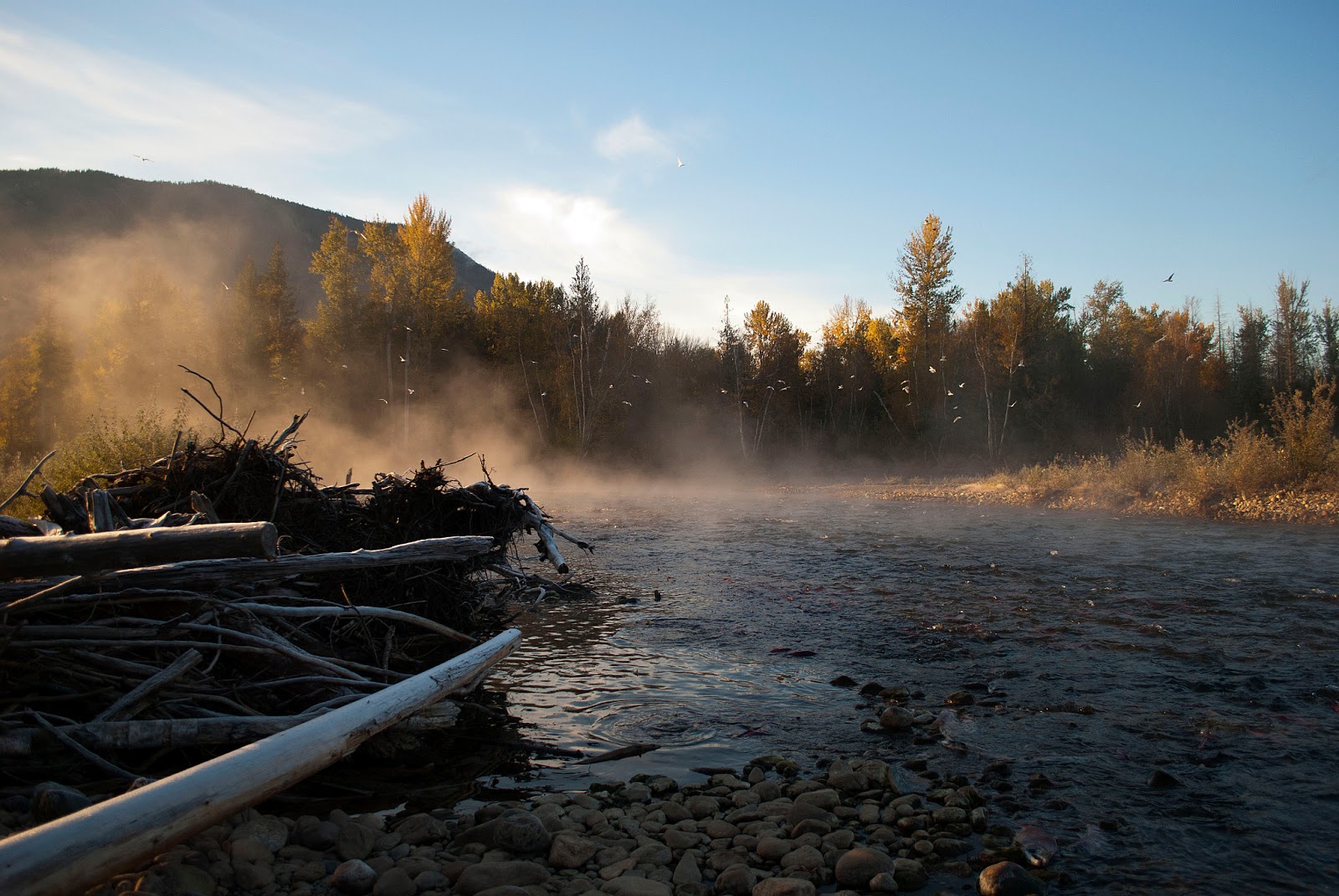
One such local attraction, the annual Salmon Run, takes place every fall in mid-October when Salmon return from the Pacific Ocean to the upper reaches of inland rivers to spawn. Flushed a deep crimson red, the spawning salmon return to the place of their birth to lay and fertilize their eggs, they then die and the life-cycle begins again.

The Adams River, forty-five minutes from our hometown of Kamloops, is one of the most important breeding grounds for Sockeye Salmon in North America, and the major reason for Roderick Haig-Brown Provincial Park's existence. Although total numbers vary by year, with every fourth year being a dominant run, anyone attending school in the area has at one time or another joined a field trip to take in this natural phenomenon.


Unfortunately, it becomes easy to overlook even the most miraculous of natural occurrences, and I never paid it much attention until 2010, when the run, the largest since 1913, made headlines with an estimated 34 million fish entering the Fraser River near Vancouver, 3.86 million of which returned to the Adams River to spawn. In addition to impressing the countless visitors, the 2010 Salmon Run also marked a remarkable rebound from 1994 when only 660,000 fish returned.

A trip to the Adams River makes for a fantastic day. The weather in Fall is crisp yet sunny, and the leaves on the trees are still changing colour. The breeding salmon, recently turned a spectacular red, bump and jockey for room to maneover themselves and to try and lay claim to the ideal breeding location, all of which makes the Adams River Salmon Run a must-see event. 


If you will be in British Columbia, Alaska, or parts of Scotland this fall, I'd highly recommend looking into notable runs in the area and making time to check out one of these incredible occurrences. The next dominant run in the Adams River will be Autumn 2014. There are also many photography and adventure tours that focus on the natural predators up stream, mainly bears, whose presence is increased due to an abundance of food. 


By Unknown with No comments

Hey there!

Calli and Travis returned from a four month trip through Europe more excited than ever to hit the open road. Who knows where they'll end up next...

  • Popular
  • Categories
  • Archives